How Fari Lens Uses AI for Hotel Inspections and Operations
A behind-the-scenes look at how Fari Lens brings computer vision to routine hotel inspections.


Hotels don’t lack standards, but what they do lack is proof. Every day, supervisors need verifiable answers to simple questions: Was the minibar inspected? Is the room clean to brand SOP? Are the fire extinguishers within date? The difference between a good day and a chaotic one is usually a missing photo, a late checklist, or a hand-off that didn’t make it from WhatsApp to the PMS.
Fari Lens addresses this gap by turning routine visual checks into structured, auditable data that can trigger work, bill correctly, and train the operation over time. It’s a computer-vision platform within Fari’s operating stack (Fari AI and Fari Analytics), designed for the realities of hotels: mixed systems, shifting teams, and the need for evidence that travels across departments.
What Fari Lens actually does
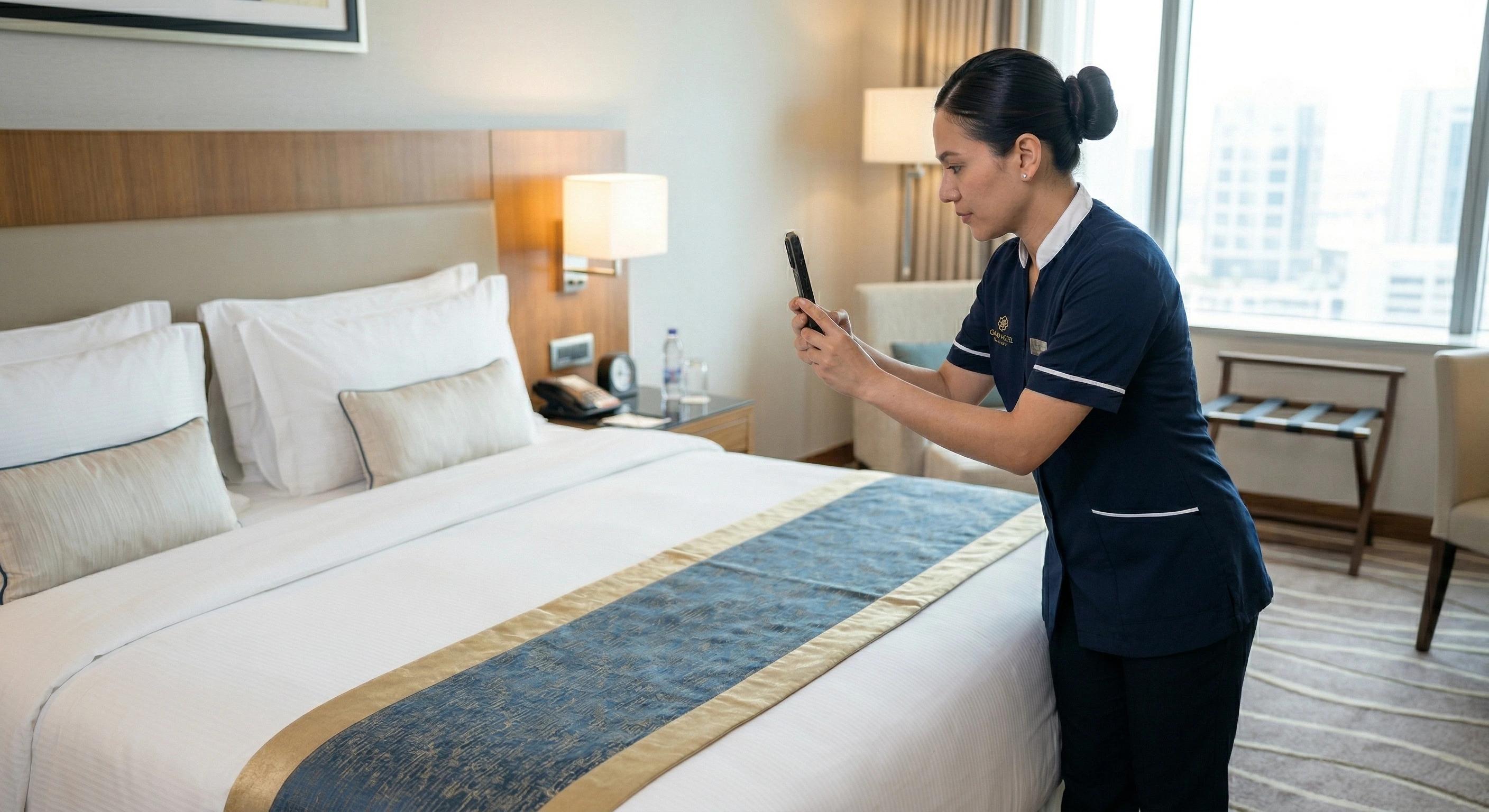
At its core, Fari Lens converts images and short videos—taken by housekeeping, minibar attendants, and F&B teams—into machine-readable observations. Those observations then map to actions: charge a folio, open a work order, flag an exception, or compile a compliance report. Because Lens sits alongside Fari AI (agents that execute cross-system tasks) and Fari Analytics (portfolio-wide dashboards), the same evidence can create both immediate outcomes and long-run insight.
Three high-frequency inspection flows
-
Minibar verification Attendants capture a quick photo sweep of fridge and tray. Lens detects SKUs, quantity deltas, and, where relevant, fill levels. It produces a reconciled list (e.g., 1× Tonic, 1× IPA), links the evidence image, and passes a structured charge to PMS/POS via Fari’s integration layer. Disputes are resolved against timestamped visuals; no more email archaeology. (See Fari’s product suite: Lens for vision, AI for actions, Analytics for outcomes.)
-
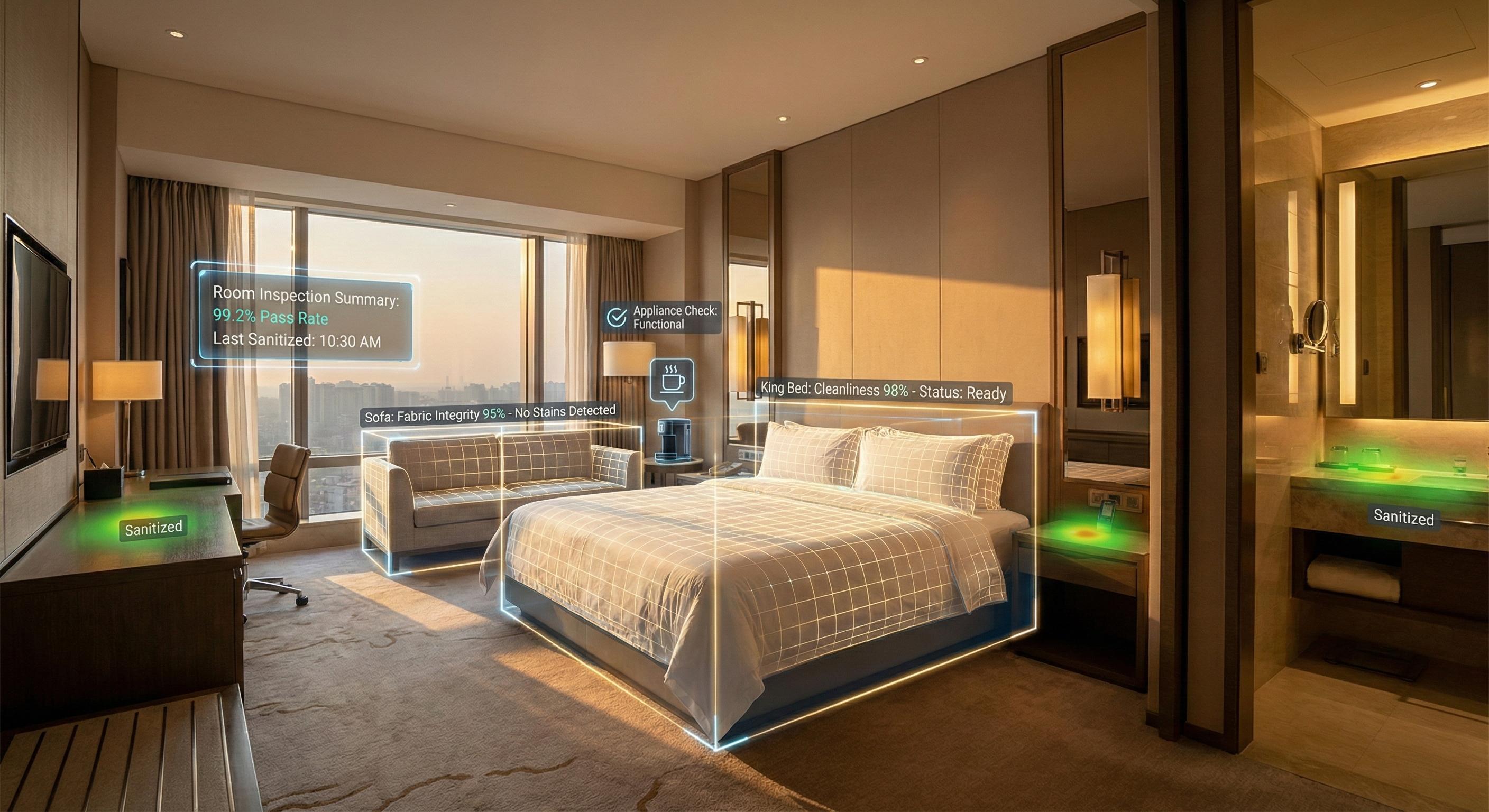
Room cleanliness and readiness Supervisors scan bathrooms and hard-to-inspect surfaces. Lens checks for common misses (amenity placement, visible debris, towel folds, consumable counts) and tags exceptions for the CMMS. Where brands have detailed SOPs, those steps become checkpoints with visual evidence and pass/fail thresholds, raising consistency without adding paperwork.
-
F&B and bar stocktaking Using shelf images, Lens identifies bottles by label and geometry, differentiates close-look SKUs, and estimates fill-level variance to accelerate cycle counts. The output posts to inventory sheets and ties to purchase plans; variance beyond tolerance kicks off a recount task.
From pixels to actions: how it works
Acquisition. Teams use mobile devices to capture scenes. Lens optimizes for irregular light, occlusions, and tight spaces typical of guestrooms and back-of-house. Recognition. Models trained on property-specific catalogs (minibar SKUs, amenity layouts, bar lists) detect items, text, and placement. Decision. Business rules—built in Fari AI—map detections to actions: charge folio, raise task, request supervisor override. Human-in-the-loop gates can be applied to high-value steps (e.g., liquor variances). Record. Encrypted images, who/when/where metadata, and result hashes form an audit trail. In Analytics, operators track exception rates by brand standard and shift.
Why this matters: In earlier Fari articles, we’ve shown that when visual evidence and system actions share a platform, hotels cut admin load and errors while improving guest touchpoints—Lens extends that logic to inspections.
Hotel-grade guardrails: privacy, roles, and compliance
Lens follows Fari’s platform controls: role-based permissions, end-to-end encryption, and audit logs, plus data-retention workflows aligned with privacy requirements (e.g., India’s DPDP Act 2023). Properties can limit where images are captured, who can see them, and how long they persist. These controls make visual automation deployable across mixed ownership and regional compliance regimes.
Where Lens plugs into the stack
- PMS & POS. Post minibar charges, hold/release items against folios, and reconcile to night audit. - CMMS/Housekeeping. Turn failed visual checks into tasks with evidence attached; auto-close on successful rescan. - ERP/Finance. Tie inventory variances and write-offs to general ledger codes with supporting imagery. - Analytics. Trend exceptions, validate SOP adherence by floor/shift, and correlate inspection rigor with guest metrics.
Impact operators can measure
Hotels using Fari’s stack report meaningful reductions in administrative drag and error rates, with fast payback when automations span multiple systems (payments, parity, night audit, staffing). Lens complements these gains by shrinking time-to-proof for inspections, improving dispute resolution, and raising first-time-right housekeeping.
Deployment playbook
- Integrate and scope. Connect PMS/POS/CMMS and define which inspections will run with evidence capture. 2) Model the catalog. Photograph property-specific SKUs and layouts; validate detection against tricky lighting and angles. 3) Define actions and gates. Configure Fari AI rules (charge → auto; variance → supervisor review). 4) Pilot with two teams. Start with one minibar zone and one housekeeping checklist; measure exception rate and time saved. 5) Roll out and monitor. Standardize across floors, then properties; review Analytics weekly to update thresholds and retrain where error clusters appear.
Why this is different
Lens is not a standalone app—it’s part of an operating system for hotels that unifies vision, action, and analysis. That’s crucial: a photo without a system effect is just storage; a charge without evidence is a dispute. Fari’s approach binds the two and lets operators prove outcomes in minutes, not meetings.