Why AI Room Inspections Matter for Atlantic City Casino Hotels
For Atlantic City casino resorts, AI room inspections can speed turnover, improve consistency, cut rework, and protect guest experience where room readiness is operationally critical.

Atlantic City’s casino resorts are not ordinary hotels with slot machines attached. They are unusually dense operating environments: large room counts, heavy weekend compression, frequent short-stay demand, major event swings, group business, nightlife traffic, and a front desk rhythm shaped as much by gaming and entertainment as by traditional lodging patterns. In that setting, the hotel room is not a side business. It is one of the core engines that keeps the integrated resort moving.
That is why room inspection matters so much here. On paper, inspection is a quality-control task. In practice, it is a revenue, labor, maintenance, and guest-experience task all at once. A room that is not inspected on time is not available for sale. A room that is marked ready but is not truly ready creates rework, escalations, and sometimes compensation. A missed maintenance issue can turn a sellable room into an out-of-order room later in the day, or worse, after check-in. In a market where timing matters and inventory is finite, those frictions accumulate quickly.
That makes Atlantic City a particularly strong case for AI-assisted room inspections. Not because the city needs gimmicks, and not because hotel teams need to be replaced, but because the scale and pace of casino-resort operations reward anything that can improve consistency without slowing down the floor. The real promise of AI in this context is simple: make inspection faster, more standardized, easier to document, and more useful as an operational signal.
It is also worth narrowing the scope. In some hotel markets, minibar automation is a major part of the room-operations story. In Atlantic City, that is not the center of gravity. Many properties either do not emphasize traditional minibars or have already simplified that workflow. The more important opportunity on the hotel side is the room itself: cleanliness verification, setup compliance, missing items, maintenance detection, and the speed with which a cleaned room can become a trusted available room.
Why Atlantic City is a special operating environment
Atlantic City’s casino hotels collectively represent a large lodging base, with thousands of rooms spread across the major casino properties. That scale matters because inspection problems are multiplicative. A minor delay in a 150-room hotel is one thing. The same delay in a resort with well over a thousand rooms becomes a system problem. Every extra minute spent walking rooms, verifying repeatable standards, rechecking items that should already be obvious, or chasing incomplete documentation has portfolio-level consequences inside a single building.
The market also runs on volatility. A midweek operating cadence can look very different from a Friday night after a concert, a fight weekend, a convention arrival, or a summer surge. In those moments, room operations are under pressure from both ends: arriving guests want access earlier, while housekeeping and inspection teams are trying to turn rooms as quickly as possible without letting standards slide. The classic tension is familiar to every hotel operator: speed and quality often pull in opposite directions.
Casino resorts feel that tension more intensely because room readiness affects more than lodging revenue. An available room affects gaming visitation, dining spend, spa usage, loyalty satisfaction, and the overall perception of the property. Integrated resorts are ecosystems. When one part slows down, the rest feels it.
What room inspection actually looks like today
Most room inspection processes still rely on some mixture of human memory, checklists, photos, supervisor walkthroughs, and judgment calls. None of those inputs is inherently bad. In fact, experienced inspectors often catch subtle issues that a rigid checklist cannot. The problem is that manual inspection becomes less reliable as volume rises. Fatigue sets in. Standards drift by shift and by supervisor. Documentation quality varies. One inspector may be strict about linen presentation and loose about bathroom setup; another may focus on amenities but miss small maintenance signals.
In large casino hotels, there is also a geography problem. Physical inspection requires movement: elevators, corridors, tower transitions, repeated room entry, repeated review of the same kinds of items. That travel time is easy to underestimate, but it consumes labor that could be spent on exceptions rather than on repetition. If a property prefers inspectors to revisit every room in person, it pays a speed penalty. If it relies more heavily on self-inspection by attendants, it risks inconsistency unless the standards are tightly structured and easy to verify.
This is why many operators are drawn to the idea of self-inspection but remain cautious about it. The attraction is obvious: the room attendant is already in the room, already touching the work, and already positioned to confirm completion. The concern is equally obvious: how does management trust the result without creating a second full inspection pass that gives back all the time savings? AI is most useful precisely in that gap between speed and trust.
What AI room inspections do well
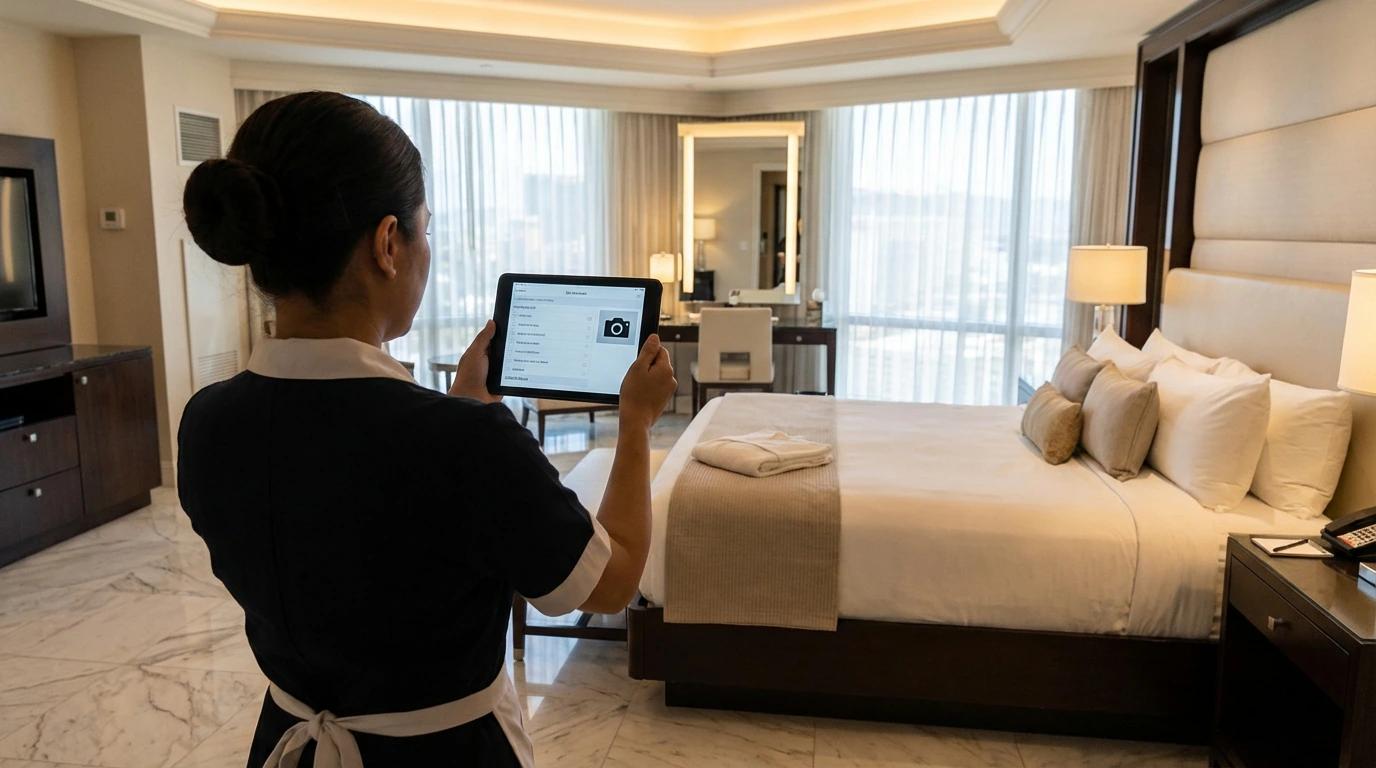
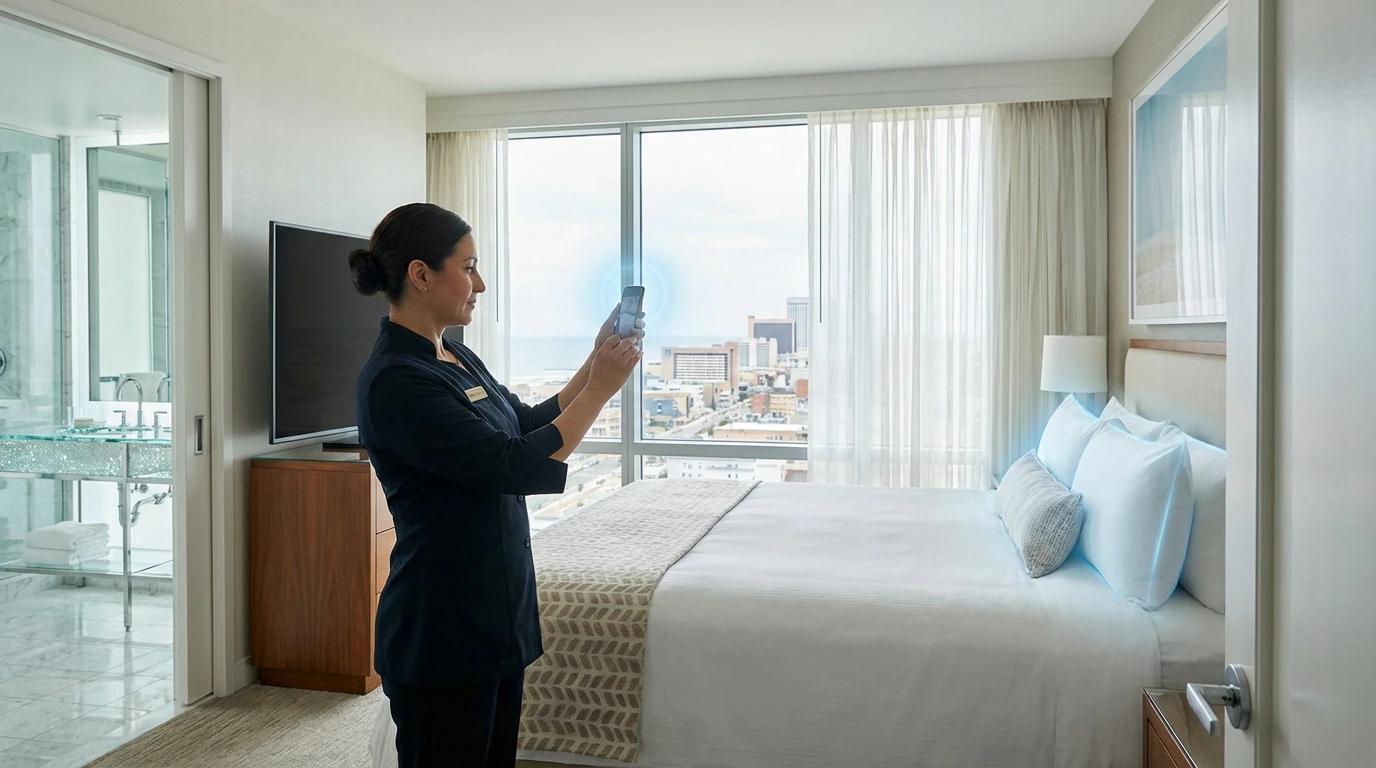
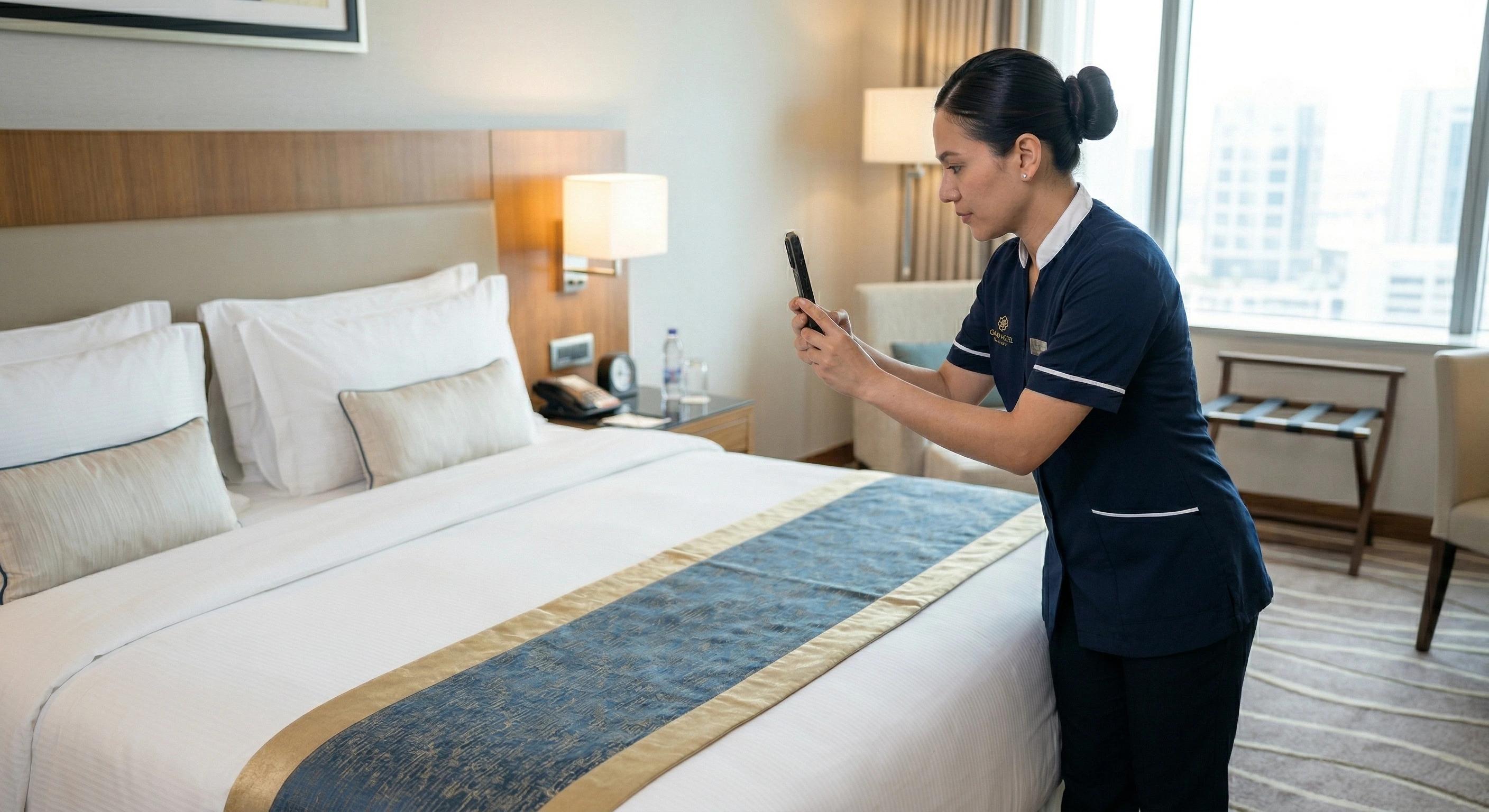
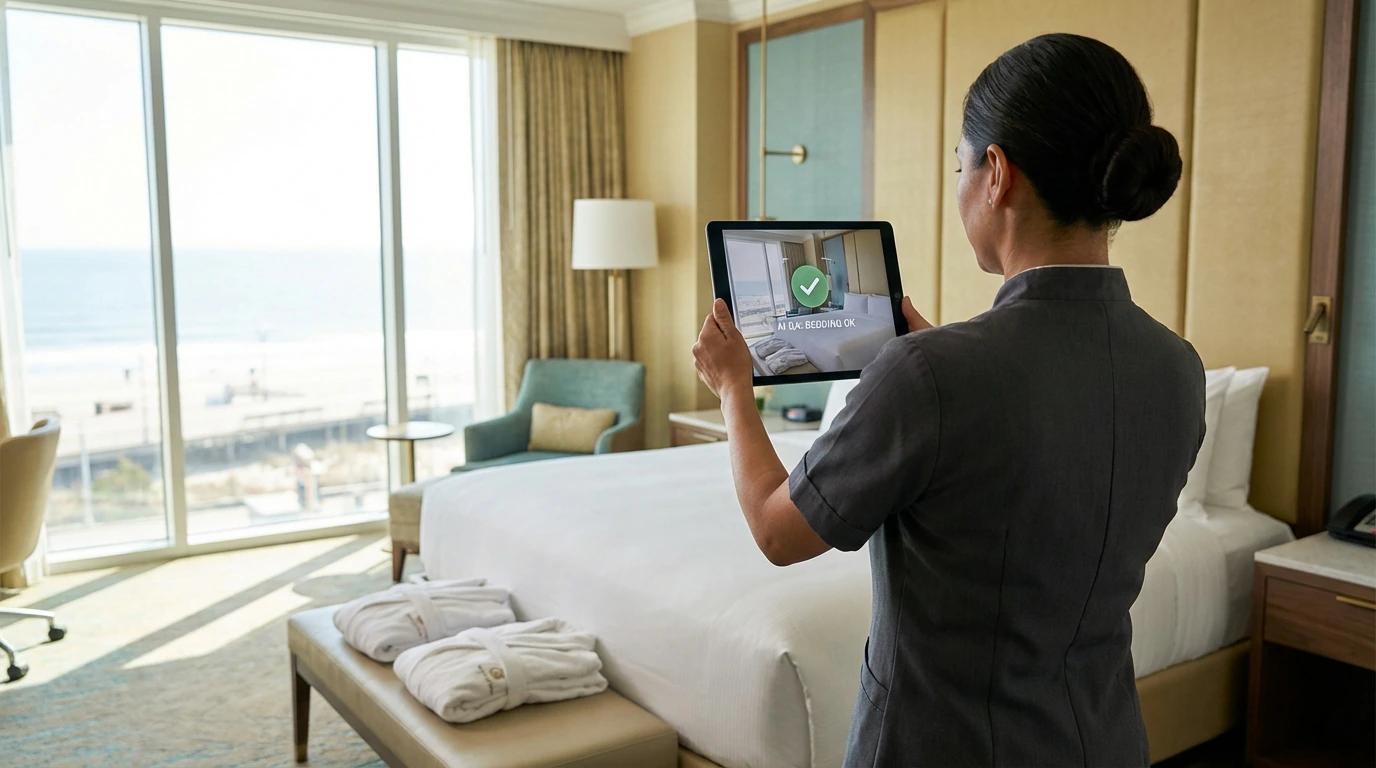
In the hotel context, AI room inspection usually means computer vision applied to visual operational checks. Staff capture images of the room or of specific room zones, and the system evaluates those images against defined standards. The key point is that the model is not meant to replace hospitality judgment wholesale. It is meant to automate the repetitive, visually verifiable part of the process so people can spend more time on true exceptions.
That includes several high-value tasks: confirming that required amenities are present, checking whether standard setup has been followed, flagging obvious stains or damage, identifying housekeeping misses, and surfacing maintenance issues early. It also creates a timestamped record, which matters more than it may seem. A room inspection that generates structured visual evidence is operationally different from an inspection that lives only in a supervisor’s memory or in a loosely completed checklist.
The best systems do not require a property to throw out its current SOPs. They sit on top of the existing standards. If a resort has a weighted inspection checklist, room-type differences, or brand-specific presentation rules, the AI layer should be trained around those realities rather than forcing the operation into a generic template. That is one reason the room-inspection use case is more practical than some of the flashier AI stories in hospitality: the problem is concrete, visual, repetitive, and already structured.
The biggest benefit: faster room turnover without blind risk
For Atlantic City casino hotels, the most immediate benefit is not abstract efficiency. It is faster, more credible room turnover. A room is valuable only when it is ready to be sold and confidently released. AI inspection helps shorten the time between cleaned and available by reducing the amount of back-and-forth needed to verify that a room meets standard.
That matters especially at peak arrival windows. If attendants can complete the cleaning, capture the required room images, and have the system quickly assess likely compliance, supervisors do not have to physically touch every room at the same intensity. They can manage by exception. Rooms that score cleanly can move forward faster. Rooms with flagged issues can be routed for follow-up. Instead of treating every room as equally uncertain, the operation starts to separate probable-ready from probable-problem.
This does not mean removing human oversight on day one. In most sensible deployments, AI reduces the number of low-value rechecks before it reduces the number of people involved. Supervisors still oversee the process, but they no longer spend as much time walking to confirm what a system can already verify with high confidence. That is how speed improves without creating a reckless release process.
Consistency is the second major gain
The hidden cost of manual inspection is variation. Two rooms cleaned to the same standard may be judged differently by different people. Two rooms with the same flaw may produce different outcomes depending on who is doing the review, how rushed they are, or how full the house is. Over time, that inconsistency affects training, morale, and guest experience. Teams start receiving mixed signals about what good looks like.
AI inspections can help create a more stable operational language. If the system is trained on the property’s actual checkpoints, the standard becomes more legible. Pillow count, towel placement, amenity presence, visible stains, missing items, and obvious setup deviations stop living solely as verbal instructions and start appearing as repeatable visual criteria. That makes coaching easier. It also makes the operation fairer, because feedback becomes less personal and more evidence-based.
In a casino-resort setting with large teams, shift changes, and variable staffing depth, that kind of consistency is not a luxury. It is a control system. It helps preserve standards when pressure rises.
Maintenance detection becomes earlier and more useful
One of the most underrated benefits of AI room inspections is that they turn housekeeping from a passive reporter of maintenance issues into an earlier detection point. Traditional operations depend heavily on either guest complaints or inspector observations to surface problems. But room attendants already see the room first and most often. The challenge is making their observations systematic rather than incidental.
A good room-inspection model can flag visible wear, stains, damage, missing fixtures, or setup anomalies while the room is still in turnover. That creates a better maintenance sequence. Instead of learning about a problem after check-in, engineering or housekeeping leadership can learn about it before the room is released. Over time, this improves not just reactive response but preventive planning. Patterns emerge: repeated issues by room type, by tower, by floor, by vendor, or by specific furnishing category.
For Atlantic City properties, where room product varies from standard inventory to suites and renovated towers, this matters a great deal. The more differentiated the room base, the more valuable it becomes to capture structured visual evidence of recurring defects rather than relying on anecdotal escalation.
Documentation improves accountability without becoming paperwork
One reason hotel teams sometimes resist new inspection tools is that they fear extra documentation work. That concern is valid. Many digital projects fail because they add clicks without removing labor. AI inspection is only useful if it makes the record more robust while keeping the process lightweight.
When it is implemented well, documentation becomes a byproduct of the inspection rather than a separate burden. The image capture is the proof. The timestamp is the audit trail. The detected issue list becomes the exception report. This is a meaningful shift. In a dispute, in retraining, in a supervisor review, or in a performance conversation, the property is no longer relying on vague recollection. It has a visual operating history.
That operating history is useful even when no guest ever sees it. It helps answer basic management questions: Are standards being missed in one tower more than another? Are certain room types taking longer to pass? Are some defects being fixed repeatedly rather than permanently? Which missed steps are most common, and which are most expensive?
Why this is a better fit than generic ‘hotel AI’ talk
A lot of AI discussion in hospitality is either too futuristic or too front-office centric. Chatbots, trip planning assistants, voice interfaces, and recommendation engines all have their place, but room inspections solve a more immediate operational problem. They sit close to labor, room revenue, and guest satisfaction. That is why the use case resonates in a market like Atlantic City. It is not asking the property to believe in a speculative future. It is asking whether repeatable visual checks can be handled more intelligently right now.
That practical quality is also why a platform such as Fari Lens can be folded naturally into the discussion rather than bolted on as a sales insert. The underlying idea is straightforward: use mobile phone cameras and computer vision models to automate visual operational checks, create timestamped records, verify room cleanliness and setup, and surface maintenance issues early. On the room-inspection side, that aligns closely with what casino hotels actually struggle with: not theory, but the everyday burden of proving that a room is truly ready.
What makes that approach interesting for casino resorts is that it can support several operating models. A property can keep traditional inspectors and use AI to reduce walking and speed up confirmation. It can move toward self-inspection by attendants while retaining digital supervisor oversight. Or it can phase the technology in gradually, using it first as a QA and training layer before allowing more automation in room-release decisions. That flexibility matters because Atlantic City operators do not all run the same housekeeping culture.
The labor story is about redeployment, not just reduction
It is tempting to describe AI inspections as a labor-saving tool and stop there. That is only partly true, and it is not the most strategic way to think about the benefit. In hospitality, especially in unionized or service-sensitive environments, the more useful question is not how many minutes disappear from payroll. It is where management wants human attention to go.
If supervisors spend less time on repetitive room verification, they can spend more time on coaching, exception handling, suite-level quality, guest recovery, and interdepartmental coordination. If room attendants receive clearer visual feedback, training can improve faster. If engineering receives earlier signals, room downtime can fall. The gain is not merely fewer inspection minutes. It is a better allocation of skilled attention.
That is particularly important in Atlantic City, where staffing pressure can be cyclical and where weekends, events, and seasonality can magnify small operational weaknesses. A property does not need AI because people are unimportant. It needs AI because people are too important to spend all day proving the obvious.
What operators should watch out for
The case for AI room inspections is strong, but the pitfalls are real. The first is overpromising. No property should assume that one model can understand every room, every lighting condition, and every service standard without training and calibration. Atlantic City resorts often have varied room types, older room inventories mixed with renovated stock, and unique suite categories. Any serious deployment has to reflect that complexity.
The second risk is confusing image capture with operational change. Taking photos is easy. Building a process that uses those photos intelligently is harder. The questions are managerial: Who captures the images? At what point in the turnover sequence? What happens when the system flags a problem? Who has override authority? When is a room automatically releasable, and when is a human signoff still required? A property that skips those decisions will collect pictures and gain little else.
The third risk is adopting generic computer vision that is not tuned to the property’s actual standards. Room inspection is not just object detection. It is standard detection. The model has to understand what that resort considers acceptable, not just what a general dataset thinks a hotel room looks like. This is where hotel-specific training and a phased rollout matter more than flashy demos.
How Atlantic City resorts should evaluate the opportunity
The right question is not, “Can AI inspect a room?” The right question is, “Where does inspection currently slow revenue, create rework, or hide maintenance, and can AI reduce that friction without weakening standards?” That framing keeps the project grounded in operations rather than novelty.
A sensible pilot would start with a defined room set, a clear checklist, and a small number of measurable outcomes: time from cleaned to ready, percentage of rooms requiring re-entry, supervisor walking time, maintenance issues caught before release, and guest complaints tied to room condition. Those are the metrics that tell you whether the system is creating operational trust. They are more useful than broad promises about transformation.
From there, the property can decide how far to push automation. Some resorts will keep AI as a decision-support layer. Others will gradually allow stronger self-inspection models, especially in standardized room categories where the system proves dependable. The most mature outcome is not “AI replaces inspectors.” It is “inspectors stop spending most of their time doing low-value confirmation.”
The broader point
Atlantic City does not need another generic hospitality technology story. It needs tools that understand the peculiar seriousness of room availability inside a casino resort. In this market, a room inspection is not merely a housekeeping ritual. It is a release valve for the entire property: front office, revenue, guest satisfaction, maintenance, and even gaming-adjacent spend all feel the effects of whether rooms are turned and trusted on time.
That is why AI room inspections deserve real attention. At their best, they do not make hospitality colder. They make the operation more legible. They shorten the distance between work completed and work trusted. They turn standards into something visible, documentable, and scalable. And in a city where big hotels live or die by how well they manage compression, turnover speed, and service consistency, that is not a marginal improvement. It is operational leverage.
For Atlantic City casino hotels, then, the value of AI room inspections is not that they sound modern. It is that they solve an old problem that still costs money every day: the difficulty of knowing, quickly and credibly, that a room is truly ready. Any technology that can answer that question better has a place in the market. The strongest room-inspection systems, including hospitality-specific approaches like Fari Lens, are compelling precisely because they answer it in the language operators already speak: speed, consistency, accountability, and fewer unpleasant surprises after the guest opens the door.