The Benefits of Fari Lens for Atlantic City Casinos and Integrated Resorts
Why Fari Lens is especially valuable on the hotel side of Atlantic City casino resorts, where room inspections, turnover speed, and consistency matter more than minibar workflows.

Atlantic City’s casino resorts are often described as gaming businesses with hotel towers attached. Operationally, that misses the point. The hotel side is not a side business. It is the mechanism that makes the wider resort work: it carries weekend compression, absorbs group demand, feeds restaurants and nightlife, anchors loyalty, and shapes the first and last impression a guest takes home. In that environment, room readiness is not a housekeeping metric in isolation. It is a revenue, service, and brand metric all at once.
That is why Fari Lens makes particular sense for Atlantic City casinos and integrated resorts when the focus is placed not on minibars, but on room inspections. In many casino hotels, the old minibar problem is either less relevant than it once was or already handled through simpler operating choices. The more consequential bottleneck is the one that remains stubbornly human, repetitive, and inconsistent: verifying that a room is actually clean, correctly set, damage-free, and truly ready to return to inventory.
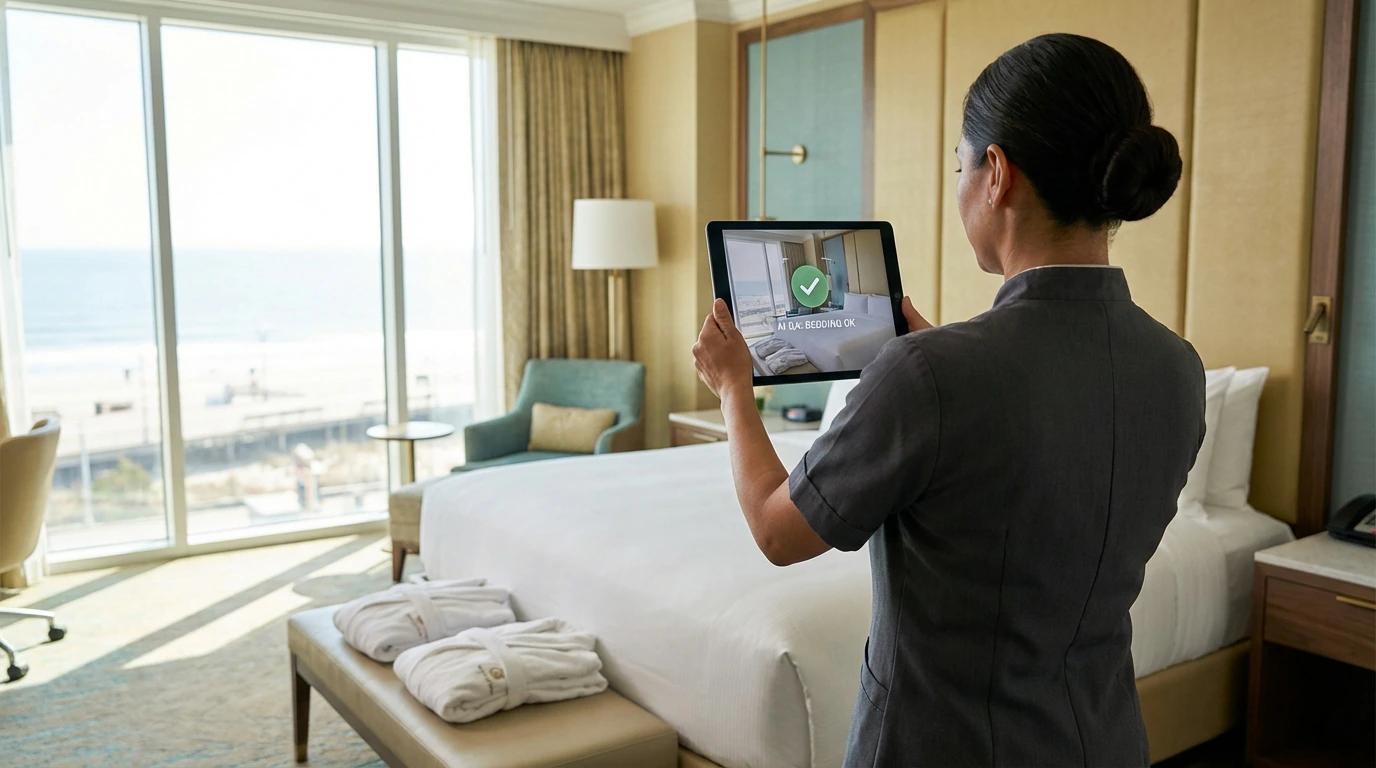
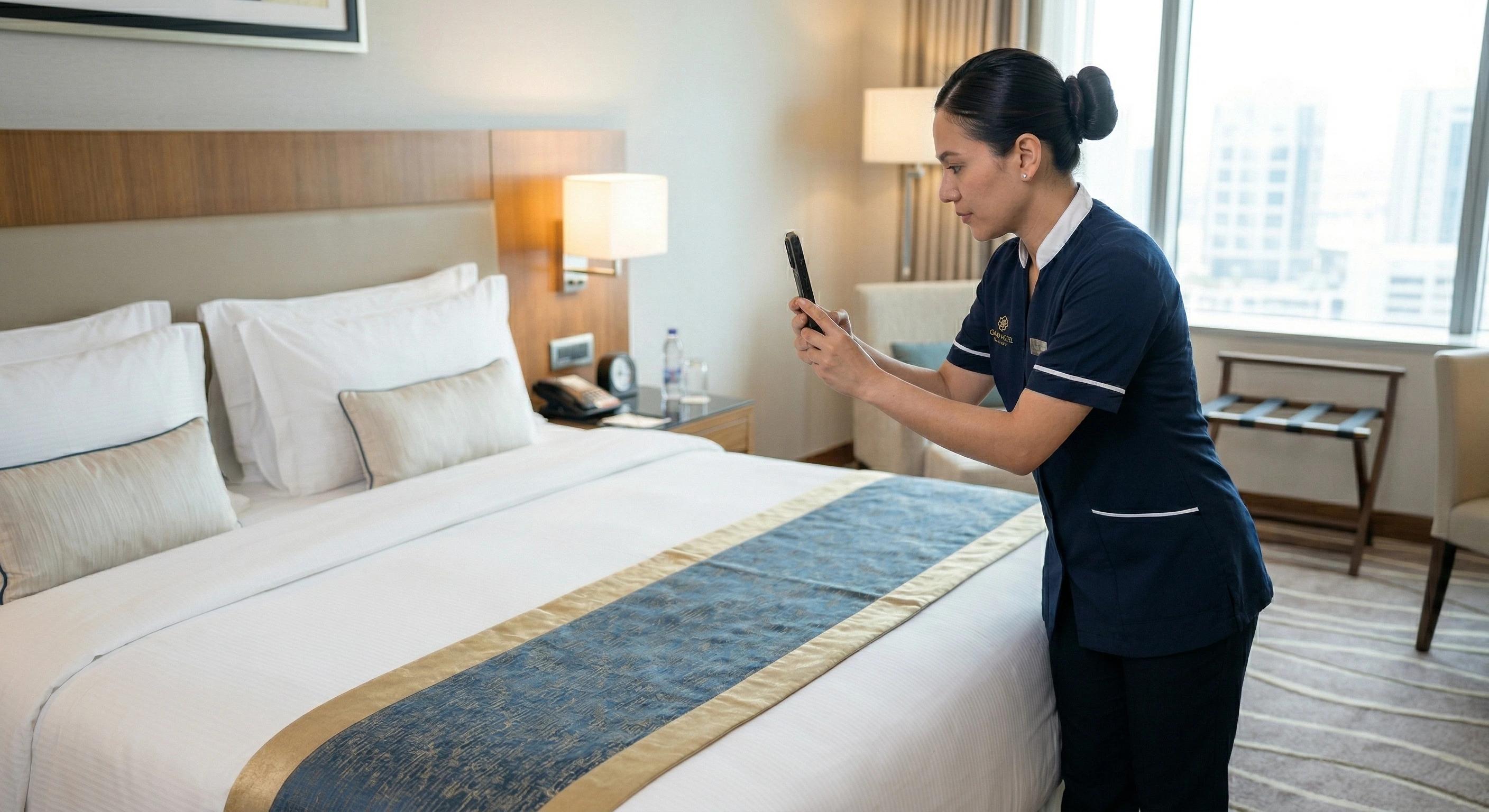
Fari Lens is built for exactly that category of work. It is a computer vision application that uses mobile phone cameras and property-specific models to automate visual operational checks. On the room-inspection side, it analyzes photos for general cleanliness, missing amenities, maintenance needs, and visible stains or damage. It also creates timestamped photographic records and can verify whether standard setup requirements, such as towel placement or amenity presentation, were followed. In practice, that means a process that has historically depended on supervisor availability and individual judgment becomes more structured, faster, and easier to audit.
Why Atlantic City is a particularly strong fit
Casino resorts place unusual pressure on hotel operations. Demand is bursty rather than smooth. Arrival banks can be intense. Weekend and event periods magnify the cost of any delay. A room that is technically cleaned but not yet inspected is not just an operational loose end; it is inventory that cannot be sold, assigned, upgraded, or confidently released to the front desk. On a large integrated property, that gap compounds quickly.
Traditional inspection models were designed for smaller-scale hospitality rhythms. A supervisor physically walks rooms, checks standards, catches what they can, and releases inventory in sequence. That method can work tolerably well in a conventional hotel. In a casino resort with long corridors, multiple towers, varied room types, VIP arrivals, irregular occupancy patterns, and constant pressure to get rooms back on the rack, the method starts to show its age.
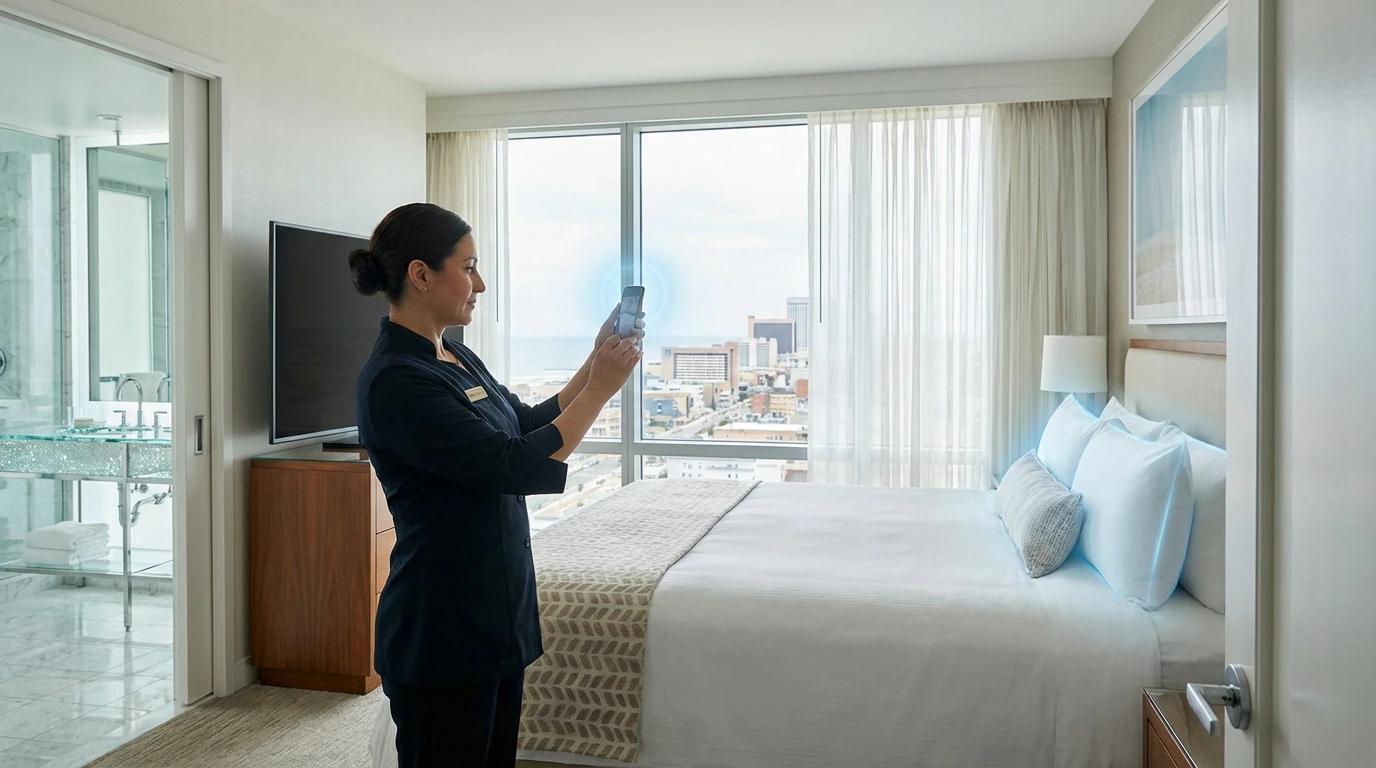
Fari Lens does not change the fact that rooms must be cleaned properly. It changes how confidence is created around that work. Instead of waiting for inspection to happen only when a supervisor physically arrives, staff can capture room images in the app, the system can assess visible conditions against the property’s standards, and managers can review exceptions digitally. That shifts inspection from a purely location-bound activity to a workflow that can be triaged, monitored, and documented in real time.
The central benefit: faster, more reliable room turnover
The first benefit is speed, but not speed in the shallow sense of moving faster for its own sake. The real advantage is compressing the time between cleaning completion and confident room release. Fari’s own room-verification workflow is designed to support faster room turnovers with instant quality verification. In operational terms, that matters because every minute of uncertainty between “cleaned” and “ready” creates downstream friction elsewhere: front desk agents hold guests longer, supervisors chase updates, managers juggle priorities manually, and valuable early-arrival opportunities disappear.
In a casino resort, that delay is not merely an inconvenience. It affects queueing at check-in, increases pressure on luggage handling and front-office staff, and can turn a potentially high-value guest arrival into a service recovery situation before the stay has really begun. A faster verification cycle therefore improves not only housekeeping efficiency but also arrival experience and inventory utilization.
One of the more revealing observations from Fari’s operating discussions is that some properties let the room attendant perform the scan immediately after cleaning, while supervisors monitor results digitally and intervene on exceptions rather than walking every room. That is a subtle but important shift. It means technology is not replacing standards; it is changing the point at which supervisory time is spent. Instead of using expensive managerial labor to confirm the obvious, the property can reserve that labor for edge cases, coaching, and truly high-risk or high-value rooms.
Consistency is the bigger prize than labor savings alone
Hotels often talk about inspection efficiency, but the more stubborn problem is inconsistency. Two supervisors may not inspect the same room the same way. One room attendant may reliably stage the room to standard; another may miss small details that erode perceived quality. During high-pressure periods, everyone becomes a little more forgiving, and standards begin to drift in ways that only become obvious after guest complaints appear.
Fari Lens is valuable because it converts a subjective process into a more repeatable one. The system can be trained to the property’s exact room layouts, standards, and recurring failure points. Fari’s deployment model is hotel-specific rather than generic: it uses on-site discovery, image collection across real conditions, baseline setup references, user permissions, and iterative model refinement. For Atlantic City properties, where room types, tower configurations, and brand expectations vary widely even within one resort, that customization matters. A system trained against the property’s own standards is much more useful than a generic “clean room” model.
The payoff is not just cleaner data. It is managerial confidence. When leaders know that room verification is being executed against a stable standard rather than individual interpretation, they can run the operation more aggressively. They can release inventory earlier, escalate fewer false alarms, and coach teams based on actual visual records rather than hearsay.
Photographic evidence changes accountability
One of the underrated advantages of Fari Lens is documentation. Every check produces timestamped photo records. That matters far beyond the narrow question of whether a room was clean at a given moment. It creates an operational memory. In most housekeeping environments, disputes and quality issues are reconstructed from fragments: a note in a system, a radio call, a supervisor’s recollection, perhaps a guest complaint logged hours later. Visual evidence is far more durable.
For Atlantic City resorts, where volume can make root-cause analysis difficult, that documentation has at least four benefits. First, it improves training because managers can show teams what “right” and “wrong” look like in the property’s own rooms. Second, it sharpens accountability because missed standards are no longer abstract. Third, it strengthens handoffs between housekeeping, front office, and engineering. Fourth, it reduces the amount of managerial time spent arbitrating what happened after the fact.
- Training improves because real room examples replace generic coaching.
- Accountability improves because there is a timestamped visual record.
- Cross-department communication improves because evidence travels better than verbal updates.
- Quality management improves because trends can be identified instead of guessed at.
The hotel-side value is really about exception management
The best hotel technology does not attempt to automate every decision equally. It helps operators separate the normal from the abnormal. That is where Fari Lens fits especially well. Most rooms, on most days, are not mysterious. They are either acceptable or they contain a small number of recurring issues: a missing amenity, an improperly staged bed, a stain, a visible maintenance problem, an item left behind, or some other defect that prevents release. The challenge is not that the industry lacks experienced people. The challenge is that experienced people are too often consumed by confirming routine rooms instead of resolving exceptions.
Fari Lens shifts the operating model toward exception-based supervision. Clean rooms move faster. Questionable rooms surface faster. Maintenance-related issues can be identified earlier. Managers spend more time where judgment matters and less time on repetitive confirmation. In a large casino hotel, this is often the difference between a team that is merely busy and a team that is actually in control.
Maintenance detection is a major hidden benefit
Room inspections are often discussed as if they were purely about cleanliness. In practice, they are also one of the earliest warning systems for maintenance. Fari Lens is designed to detect visible maintenance needs and damage as part of the same image-based workflow. That is important because many guest complaints that appear to be “housekeeping problems” are actually unresolved maintenance defects or minor room-condition issues that should have been caught earlier.
In Atlantic City, where many properties compete not only on rate but on perceived freshness and reliability of the room product, early detection matters. A scuffed fixture, stain, missing item, damaged furnishing, or visible wear issue may not individually seem catastrophic, but these details accumulate into the guest’s judgment of whether the room feels cared for. Computer vision is useful here because it shortens the lag between problem creation, problem identification, and problem routing.
This is where Fari Lens also connects naturally to a broader Fari operating model. Even when Lens is deployed as a standalone application, it produces structured operational data that can later feed workflows and analytics. With integrations, maintenance issues can route directly into work-order systems, housekeeping priorities can be adjusted, and managers can begin to see not just isolated defects but patterns by floor, room type, tower, or team. On a resort campus, that kind of visibility is more valuable than another dashboard because it ties visible conditions to actual action.
Why this matters more than minibar automation in Atlantic City
There is a reason to emphasize inspections over minibars in this market. Even where minibars exist, they are often no longer the defining operational headache they once were. Some properties have reduced them, simplified them, or already handled them through other controls. But no hotel has solved the room-readiness problem simply by deciding not to stock a minibar. The room still has to be inspected. The setup still has to be correct. Damage still has to be caught. Amenities still have to be present. And the room still has to move from “cleaned” to “sellable” without unnecessary friction.
That is why Fari Lens remains highly relevant even if minibar automation is not the lead use case. The broader value proposition is not “camera-based counting.” It is turning visual operational checks into structured, timestamped, operationally useful data. On the hotel side of an Atlantic City resort, room inspections are the clearest and most immediate expression of that value.
It improves guest experience by making operations less visible
Guests rarely compliment a hotel because its room-inspection process felt advanced. What they notice instead is the absence of friction. Their room is ready when expected. The setup feels complete. The bathroom is properly staged. There is no stray damage, no missing amenity, no obvious oversight that suggests the operation is rushing. In other words, the guest experiences the output of a good room-inspection system without ever needing to think about the system itself.
This is an important distinction. Technology on the hotel side should not merely digitize back-of-house work; it should reduce the chances that back-of-house instability leaks into the guest experience. Fari Lens contributes to that by tightening quality verification, reducing the time rooms sit in limbo, and catching visible issues before check-in rather than after complaint.
The best hotel operations technology is felt as calm, not spectacle.
For managers, the value is better control at scale
Integrated resorts create a scaling problem for management. The larger the property, the harder it becomes for leaders to know whether standards are truly being met in real time or merely reported as met. Manual inspection regimes often compensate by adding more layers of supervision, more checklists, and more reactive follow-up. That can work, but it is expensive and still leaves blind spots.
Fari Lens offers a different route. Because the app is role-based and task-driven, staff can receive assigned checks, capture evidence in the field, and produce progress data as the day unfolds. Managers gain a clearer view of what has been checked, what passed, what failed, what needs rework, and where the operation is getting stuck. The point is not surveillance for its own sake. The point is that visibility becomes operational, not anecdotal.
That is especially useful in casino resorts where labor coordination is constantly competing with guest volume. A digital inspection workflow gives leaders the ability to redeploy attention quickly. If one tower is falling behind, if one room type shows recurring defects, or if one standards category is producing repeated failures, management can respond based on patterns rather than waiting for complaints or end-of-shift summaries.
The implementation case is stronger than many operators assume
One reason some hotel operators hesitate around computer vision is the assumption that deployment must be heavy, intrusive, or dependent on a complete systems overhaul. Fari Lens is better understood as a focused operational layer. It can function without requiring full integration into existing systems, and then expand through APIs where that adds value. That matters for casino hotels, which often have a complicated technology environment and a justifiable skepticism toward projects that demand too much organizational disruption up front.
Fari’s rollout approach is also practical. Discovery identifies the priority use cases. Images are gathered in the real property. Models are refined against the hotel’s own layouts and standards. Staff training is compact rather than burdensome. Properties can begin with a defined operational problem, prove value, and then broaden scope. For Atlantic City, that means a resort does not need to treat room inspections as part of some grand digital transformation narrative. It can start with the simple question that matters most: how do we get rooms back faster without lowering standards?
- Start with one tower or room cluster where turnover pressure is highest.
- Train the model against that property’s exact room standards and recurring defects.
- Let room attendants or inspectors capture scans as part of the existing workflow.
- Route only exceptions to supervisors for physical follow-up.
- Measure release speed, rework volume, complaint incidence, and maintenance catches before scaling.
What success would actually look like
The strongest case for Fari Lens in Atlantic City is not a futuristic one. It is a grounded one. Success would look like fewer rooms waiting unnecessarily for inspection. It would look like supervisors spending less time walking routine rooms and more time resolving exceptions. It would look like more visible defects caught before check-in. It would look like better documentation when service lapses occur. It would look like cleaner coordination between housekeeping, front office, and engineering. And over time, it would look like a hotel operation that becomes calmer precisely because its standards are easier to verify at scale.
This is where Fari Lens aligns well with the realities of casino-resort hospitality. Atlantic City properties do not need technology that sounds impressive in a pitch deck but struggles in real operating conditions. They need tools that help teams move rooms faster, protect standards, reduce avoidable friction, and make management more certain about what is happening on the floors. Room inspection is one of the clearest places where those gains are available.
The bottom line
For Atlantic City casinos and integrated resorts, the most compelling benefit of Fari Lens is not that it can automate a minibar workflow if needed. It is that it can modernize one of the hotel operation’s most consequential and least glamorous processes: proving that a room is truly ready. By turning inspection into a faster, more consistent, evidence-backed workflow, Fari Lens helps resorts release inventory sooner, maintain standards more reliably, catch maintenance issues earlier, and keep operational turbulence from spilling into the guest experience. In a market where the hotel tower is inseparable from the larger resort economy, that is not a minor improvement. It is core infrastructure for better hospitality.