The Benefits of Fari Lens for Australian Hotels
Why computer vision matters now for Australian hotels: faster room turns, tighter minibar control, clearer audits, and more resilient operations under labor pressure.

Australian hotels are operating in a market that is, at once, strong and unforgiving. Demand has come back. International visitation is rising again. Major-city hotel performance is healthy. But the daily mechanics of running a property remain labor-intensive, margin-sensitive, and vulnerable to inconsistency. That is the backdrop in which a product like Fari Lens becomes interesting. It is not interesting because “AI” is fashionable. It is interesting because hotels still depend on thousands of visual checks that are slow to perform, difficult to standardize, and expensive to get wrong. Australia’s tourism economy added 736,800 tourism jobs in the December 2025 quarter, up 4.7% year over year; at the same time, job vacancies rose in customer-facing sectors including accommodation and food services, a reminder that growth and labor tightness can coexist.
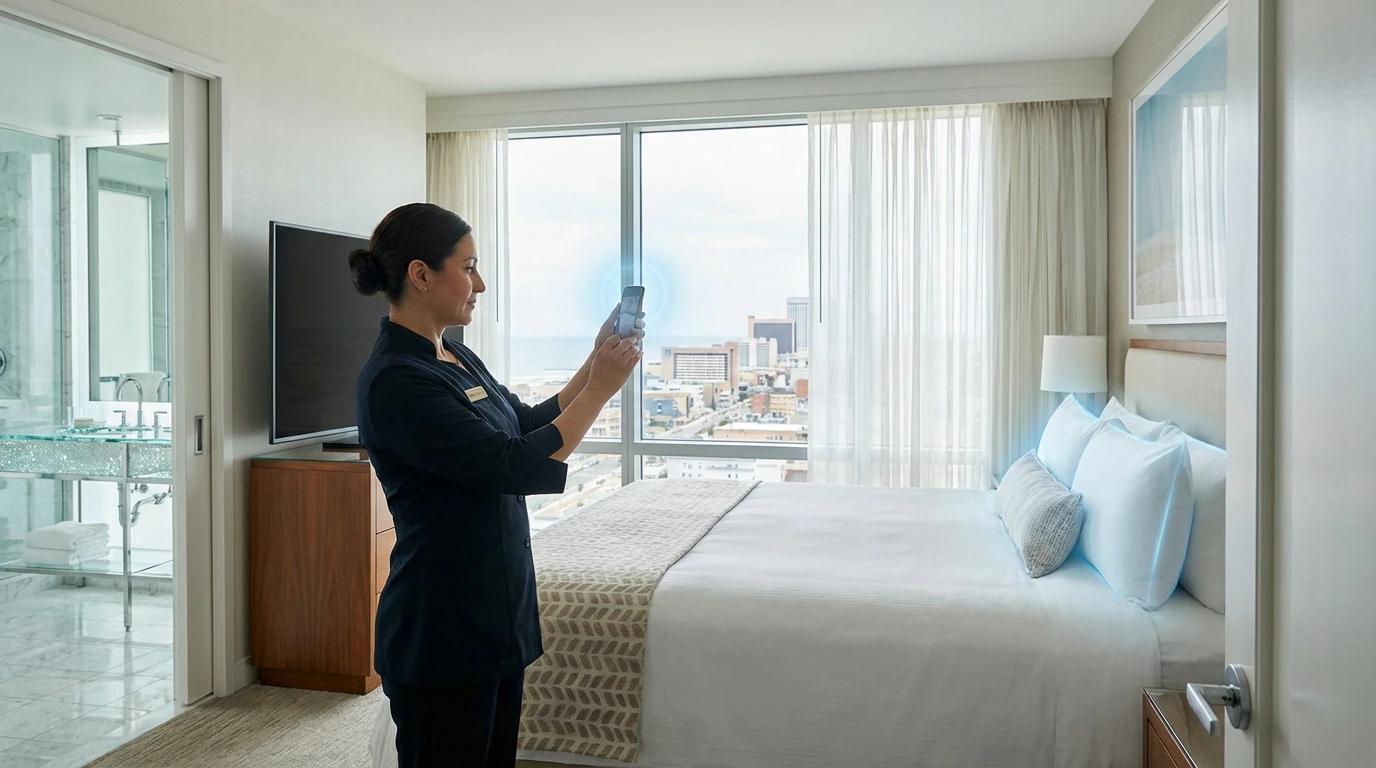
Fari Lens is a computer-vision application built for hotel operations. In practice, that means staff use a phone camera to capture a room, a minibar, or another operational area, and the system analyzes what it sees against the property’s standards. According to Fari’s platform overview, the product is designed to automate visual operational checks, reduce manual counting, lower labor costs, minimize revenue leakage, and provide real-time operational visibility, even without mandatory integration into a hotel’s existing systems.
Why the Australian context matters
This matters more in Australia than a generic hospitality-tech article might suggest. Hotels here are serving a market where visitor demand has recovered strongly, especially in major cities, while operating teams still face the classic pressures of labor availability, quality assurance, and cost discipline. Tourism Research Australia reports 8.3 million international trips in the year ending December 2025, with spend in Australia up to $39.2 billion, and CBRE says RevPAR growth exceeded 8% across most major Australian cities in 2025, led by Sydney and Brisbane. In other words, many hotels are selling into healthy demand, but that does not make their operations simpler; it makes execution more consequential.
Australian operators also continue to feel labor pressure. Jobs and Skills Australia shows accommodation and food services employing 967,200 people as of February 2026, with a 61% part-time share and median weekly earnings below the all-industry median. ABS data released in April 2026 also showed vacancies rising in accommodation and food services. That combination matters because it means hotel leaders cannot assume that quality problems will simply be solved by hiring more supervisors or adding more manual checks.
The central promise of Fari Lens is not that it replaces hospitality judgment. It is that it makes visual work more consistent, faster to verify, and easier to prove.
Benefit 1: Faster, more consistent housekeeping quality control
Housekeeping is one of the clearest use cases because it combines time pressure with brand risk. A room can look acceptable at a glance and still fail on the details that trigger complaints: a missing amenity, an incorrectly made bed, a stain that was overlooked, or a maintenance issue that housekeeping noticed but never escalated. In a strong-demand environment, every delay in turning a room matters. In an online-review economy, every lapse in cleanliness matters twice.
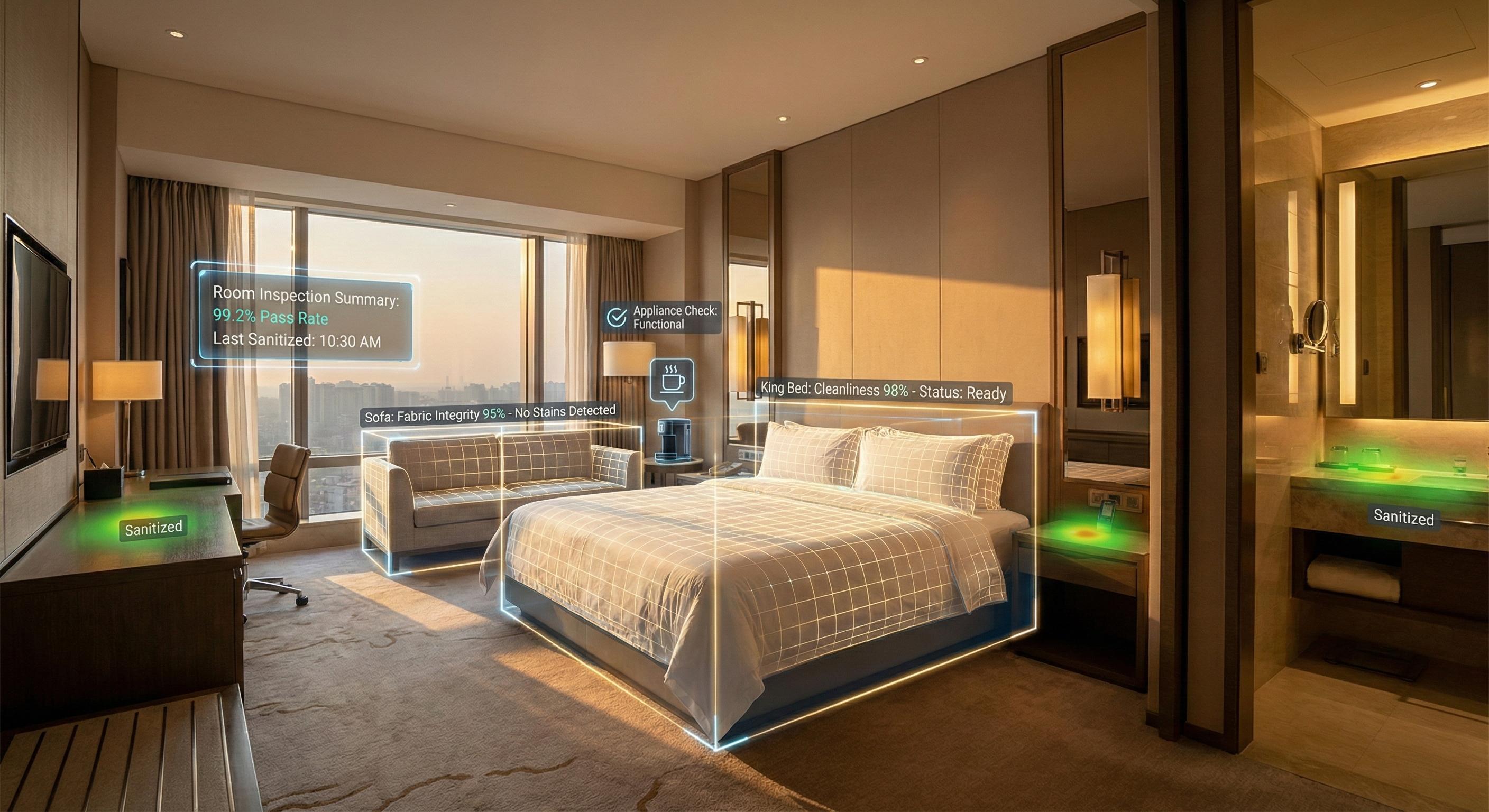
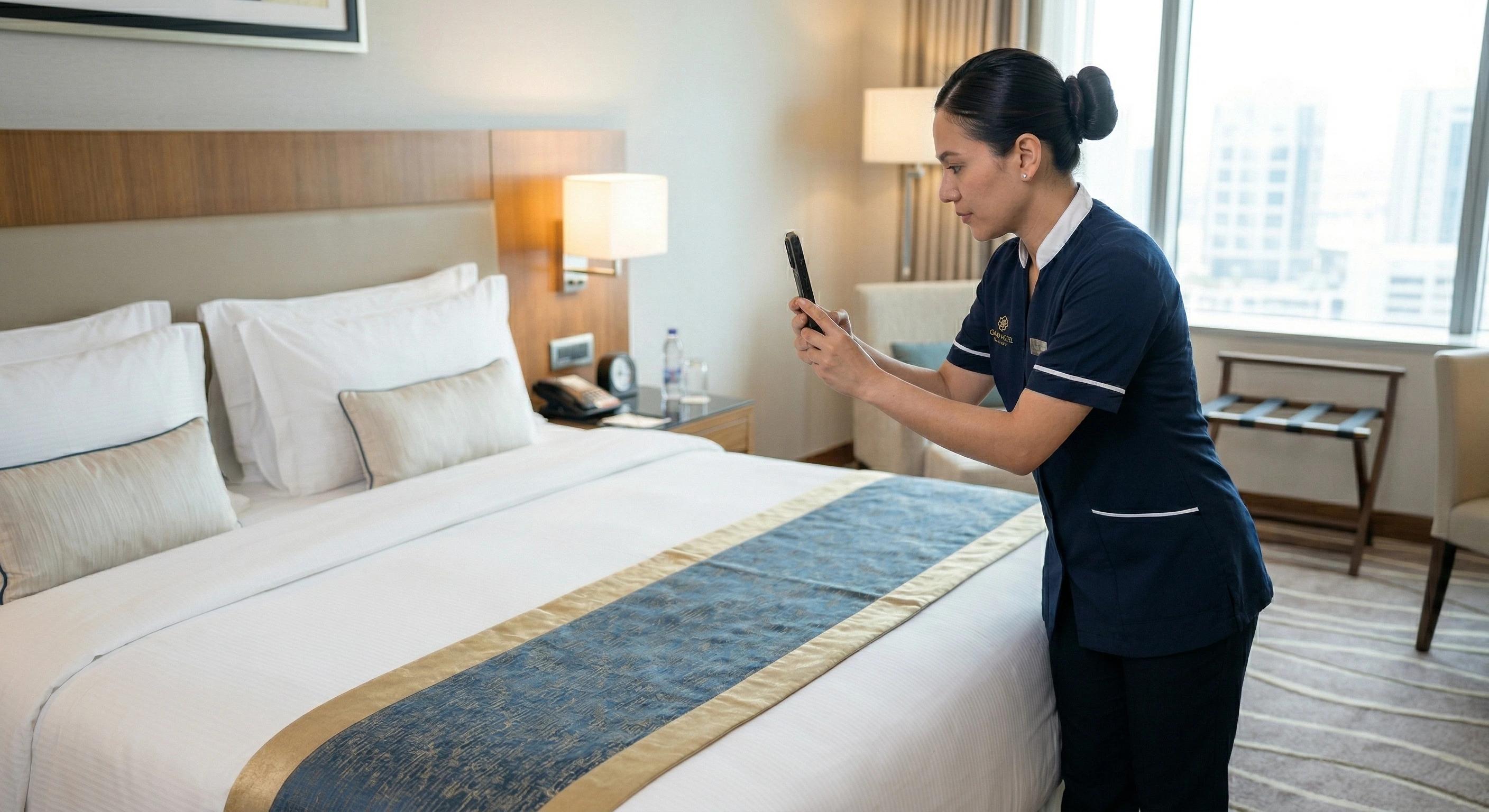
Fari’s product materials describe a workflow in which staff photograph the room in the app and the system checks for general cleanliness, missing amenities, maintenance needs, stains or damage, and whether standard operating procedures such as towel placement and amenity setup were followed. The result is a timestamped visual record, faster room-quality verification, and earlier detection of maintenance issues before they become guest-facing problems.
For Australian hotels, the practical benefit is less abstract than “better quality.” It is better throughput under pressure. When occupancy is high, supervisors do not have the luxury of slow, room-by-room reinspection. A computer-vision layer can shorten the loop between “room cleaned,” “room verified,” and “room released for sale.” That matters not only in city hotels handling compressed arrival waves, but also in resort and regional properties where staffing flexibility is often thinner. Independent housekeeping specialists in Australia continue to emphasize consistent cleaning standards, regular quality audits, and performance tracking because cleanliness still shapes reviews and brand perception in 2026. Fari Lens essentially digitizes that quality-assurance function and makes it operational rather than occasional.
- Less supervisor time spent on repetitive inspections
- More consistent adherence to room standards across shifts and teams
- Faster room release, especially during peak check-in windows
- Better documentation for training, accountability, and dispute resolution
Benefit 2: Minibar revenue capture without the usual friction
Minibar operations are a small category in some hotels and a meaningful revenue line in others, but in both cases they share the same weakness: they are visually verified and therefore prone to missed charges, inconsistent restocking, and avoidable disputes. A manual minibar check is a classic hospitality task that is simple in theory and messy in execution. Someone has to open the room, inspect the contents, identify what is missing or moved, record it correctly, and ensure the information gets acted on. When teams are rushed, these steps fray.
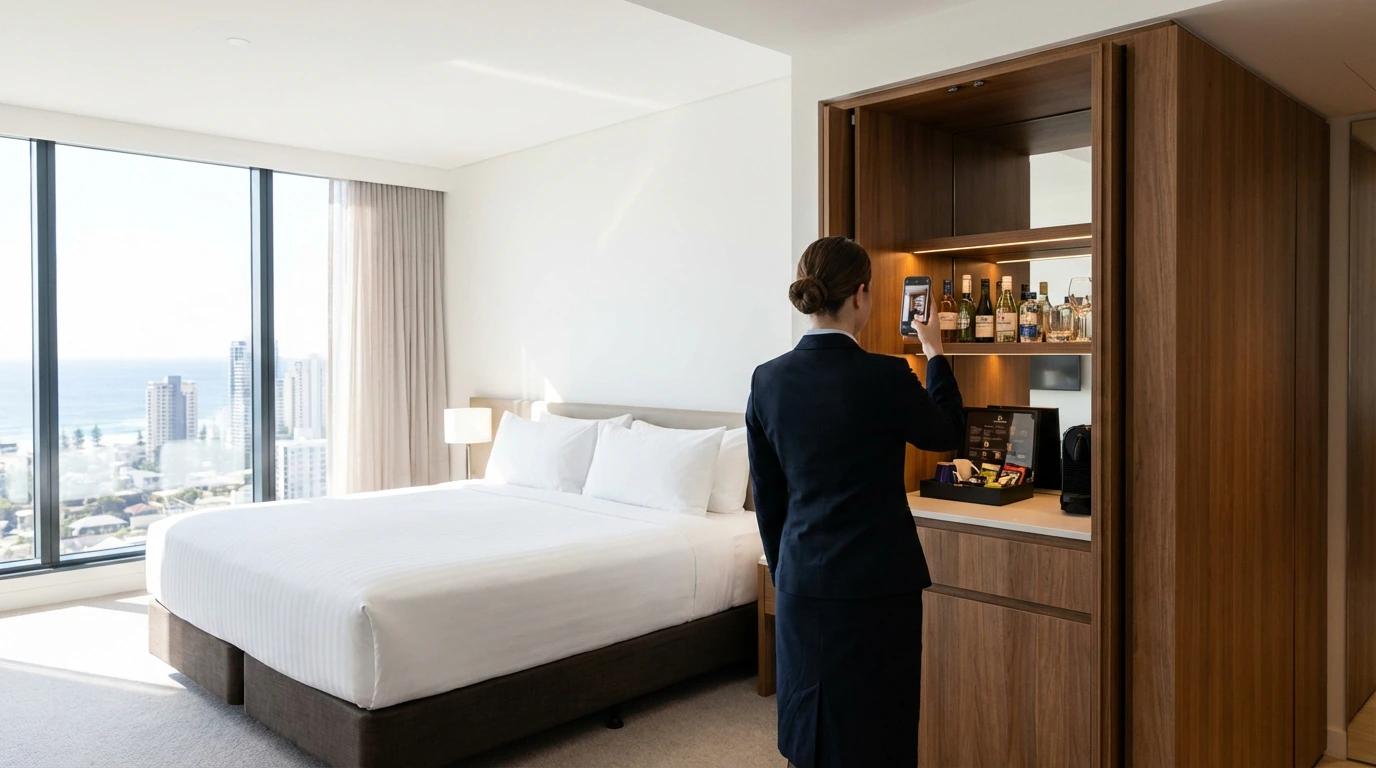
Fari Lens addresses this directly. Fari’s overview says staff can photograph the minibar and the model identifies missing or moved items, detects consumption, generates a restocking list, and logs results with timestamps and photo evidence. The same document cites typical results including a 70% reduction in time spent on minibar checks and a 15-30% increase in captured minibar revenue by catching previously missed consumption. It also emphasizes the operational value of photographic evidence in reducing guest disputes.
That combination is particularly useful for Australian hotels that sit at different points on the market spectrum. In luxury and upper-upscale properties, the minibar is often less about volume and more about precision, premium product control, and auditability. In select-service or mixed-use properties, the appeal may be simpler: if the minibar exists, it should pay for itself without consuming outsized labor. Fari Lens lets hotels treat minibar checking as a quick image-capture workflow rather than a mini stocktake performed dozens or hundreds of times a day.
Why that matters beyond revenue
The obvious gain is better charge capture. The less obvious gain is operational calm. When guest charges are supported by a timestamped image, the front desk is less exposed, accounting has cleaner evidence, and the hotel spends less time turning a $14 disagreement into a 20-minute service recovery exercise. In a business where labor hours disappear into small exceptions, reducing those exceptions is often more valuable than the raw dollar amount of the item itself.
Benefit 3: Better maintenance visibility from the same inspection workflow
One of the quietest but most important advantages of visual operations software is that it collapses the boundary between inspection and escalation. In many hotels, housekeeping sees problems first: a chipped surface, a broken fitting, damaged linen, an amenity holder gone missing, a stain that is really a maintenance issue, a minibar door not closing properly. But the reporting path from observation to action is often fragmented. Someone notices. Someone tells someone. A note is made. A task may or may not be raised.
Fari Lens is valuable here because the room scan is already happening. The same capture that verifies cleanliness can also surface maintenance needs. Fari’s materials explicitly frame room cleanliness and maintenance verification as a joint use case, with early detection helping prevent issues from escalating. And when integrated by API, maintenance issues can be routed directly into work-order systems.
For Australian hotels, especially multi-property groups or properties in labor-constrained regional markets, that is meaningful because deferred maintenance is rarely just an engineering problem. It becomes a revenue problem when rooms cannot be sold, a review problem when issues reach the guest, and a staffing problem when teams spend more time chasing information than fixing the issue itself. A visual layer that produces evidence at the moment of inspection can reduce that lag.
Benefit 4: Standardization across properties, brands, and team experience levels
Australian hotel groups often operate with a mix of metropolitan hotels, airport properties, resorts, and regional assets. Even when the brand standards are clear on paper, execution varies because physical layouts differ, staffing structures differ, and managers inevitably train teams in slightly different ways. That variation is not always visible until a guest notices it or an owner asks why one property is consistently outperforming another on room readiness or guest complaints.
Fari Lens’s development process is built around hotel-specific customization rather than a generic model. Fari says the platform is fine-tuned to each property’s layouts, inventory mix, and operational standards, using a hybrid AI approach and substantial image collection during setup. In plain terms, that means the system can learn what “correct” looks like for one hotel and then apply that standard consistently.
That has an underrated managerial benefit: it reduces the extent to which quality depends on who happens to be on shift. A new room attendant, an agency cleaner, or a less experienced supervisor can work within a more structured, more objective process. That does not eliminate training. It makes training stickier, because the standard is reinforced in the workflow itself rather than left entirely to memory and spot-checking.
Benefit 5: Real-time operational visibility instead of end-of-shift hindsight
Hotels often know what happened only after a shift is over. Which rooms were checked? Which still need restocking? Which inspections passed? Which charges were disputed? Which maintenance issues are recurring? Data exists, but it is spread across paper lists, chat messages, PMS notes, and people’s memory. The cost of that fragmentation is not just slower reporting. It is slower decision-making while the shift is still in motion.
Fari’s overview highlights centralized dashboards showing room-check statuses, revenue performance, and operational metrics, as well as invoice pages tied to photo-verified charges. The mobile app also uses role-based task management, preferred-language workflows, real-time progress tracking, and timestamp verification.
For an Australian hotel operator, this is where the product shifts from being a point solution to being a management tool. A supervisor can see which rooms still require attention. An F&B or rooms leader can see where minibar restocking is lagging. A GM can ask not only whether standards exist, but whether they are actually being executed. And in a market where hotel performance is strong enough that every extra sellable room and every avoided complaint matters, that visibility has commercial value. CBRE’s 2026 outlook and 2025 performance commentary both point to a market where demand is real and rates are healthy; under those conditions, operational leakage becomes more expensive, not less.
Benefit 6: Lower dependence on heavy systems integration at the start
One reason hotel technology projects stall is that they are asked to solve everything at once. Integration becomes the whole project. Weeks pass in mapping data, permissions, and middleware before operations teams see any practical gain. Fari Lens is notable because it can deliver standalone value before full integration. Fari explicitly states that the application can work without requiring integration with existing hotel systems, while still offering optional APIs for end-to-end automation where the property wants it.
That is a meaningful benefit for Australian hotels with heterogeneous tech stacks, managed properties operating under brand constraints, or owners that want a fast pilot before committing to broader systems work. It lowers the threshold for experimentation. A hotel can start by improving inspections and evidence capture, then later connect the workflow to PMS posting, housekeeping prioritization, replenishment logic, or maintenance ticketing. Strategically, that is often the right order: prove the operational behavior first, then automate the downstream steps.
Benefit 7: A clearer labor story in a tight staffing market
Australian hospitality labor challenges are often discussed in terms of shortages, pay, and recruitment. Those matter, but hotels rarely fix the problem by staffing alone. They fix it by redesigning work so that skilled employees spend less time on low-value repetition and more time where judgment and service actually matter. This is where Fari Lens has a quietly strong case. It does not need to eliminate roles to create value. It only needs to compress the amount of time spent on repetitive visual verification and reduce the amount of rework created by missed details.
That argument is especially relevant in a sector where part-time work is high, turnover is historically elevated, and median earnings remain modest. Jobs and Skills Australia reports a 61% part-time share for accommodation and food services, while ABS employee earnings data places the industry at the bottom of the major-industry median weekly earnings table. In that environment, software that makes standards easier to execute and exceptions easier to identify can improve resilience even before it shows up as a dramatic headcount reduction.
What Australian hotels should evaluate before adopting it
The strongest case for Fari Lens is not universal. It is strongest where visual checks are frequent, standards matter, and inconsistency is costly. A luxury hotel with minibars, detailed room setup requirements, and strong review sensitivity is an obvious fit. So is a busy city hotel trying to protect room readiness during compressed arrival periods. A resort with dispersed inventory and multiple operational touchpoints may also benefit. A limited-service property with minimal F&B complexity may still find value, but the payoff will likely come more from room-quality verification and maintenance capture than from minibar workflows.
- How much supervisor time is currently spent on manual room inspection?
- How often do missed minibar charges or weak evidence create disputes or leakage?
- How quickly are housekeeping-detected maintenance issues turned into action?
- How much variation exists between properties, shifts, or managers in what “passing standard” means?
- Would a standalone pilot create value before deeper systems integration is required?
The larger point
The case for Fari Lens in Australian hotels is ultimately a case for operational clarity. Hotels have always depended on visual labor: checking, counting, confirming, restocking, spotting, escalating. The industry has been good at training people to do that work and less good at systematizing it. Fari Lens turns some of that invisible operational burden into structured data and timestamped evidence. That is why its benefits are broader than “AI efficiency.” They include faster room turns, more reliable minibar capture, earlier maintenance detection, cleaner audit trails, more consistent standards, and better use of scarce labor.
In a buoyant Australian market, where tourism demand has recovered and major-city hotel performance is strong, the commercial logic is straightforward: once demand returns, execution becomes the differentiator. Hotels do not need more dashboards for their own sake. They need fewer blind spots in the work that determines whether a room is ready, whether a charge is valid, whether a defect is caught, and whether a standard is actually being met. For the right property, that is the real benefit of Fari Lens.