How AI Room Inspections Improve Operational Efficiency in Hotels
AI-powered room inspections help hotels reduce delays, standardize quality, catch issues earlier, and turn housekeeping data into faster operational decisions.

Hotels run on timing. A room that is cleaned but not verified is not yet sellable. A maintenance issue that goes unnoticed at 11 a.m. can become a guest complaint by 4 p.m. A supervisor who spends the afternoon walking floors with a clipboard is spending less time coaching staff, clearing bottlenecks, and preparing for arrivals. In most properties, room inspections sit at the center of this quiet operational tension: they are essential to quality, but stubbornly manual.
For decades, the process has barely changed. A room attendant finishes cleaning. A supervisor or manager checks the room. Notes are recorded, often inconsistently. Housekeeping, front office, and engineering may each receive part of the story at different times. The result is familiar to anyone who has operated a hotel at scale: delays in room readiness, uneven inspection standards, missed defects, repeated rework, and a flow of information that moves more slowly than the guest journey itself.
AI room inspections offer a different model. Instead of treating inspection as a final manual checkpoint, they turn it into a structured, visual, and data-rich operating process. With Fari Lens, hotels can use computer vision to evaluate room conditions, document visual evidence, and feed inspection outcomes into broader operational workflows. What changes is not simply the speed of inspection, but the way the hotel understands and acts on room status in real time.
Why traditional room inspections create friction
The weakness of manual inspection is not that people are careless. It is that people are variable, and hotel operations are complex.
One supervisor may focus heavily on bathroom presentation, another on minibar placement, another on amenity consistency. Two people can inspect the same room and emerge with different judgments. On a busy day, standards compress further. When arrivals are stacking up and radio traffic increases, the pressure to clear rooms quickly can overtake the discipline required to inspect them thoroughly.
This creates three operational problems at once.
First, manual inspections are slow. Even efficient teams lose time moving between rooms, documenting issues, relaying findings, and confirming that fixes have been completed. At portfolio scale, these minutes accumulate into meaningful labor drag.
Second, manual inspections are difficult to standardize. Brand standards may be consistent on paper, but execution varies by shift, by manager, by staffing level, and by property culture. That inconsistency affects not only cleanliness, but also the guest’s perception of reliability.
Third, manual inspections generate weak data. A checklist may confirm that an inspection occurred, but it rarely produces structured insight into what is failing most often, which room types create the most rework, which attendants need coaching, or which defects repeatedly delay room release.
Hotels have spent years trying to solve these issues through more training, more supervision, and more reporting. AI changes the equation by redesigning the inspection workflow itself.
What AI room inspections actually do
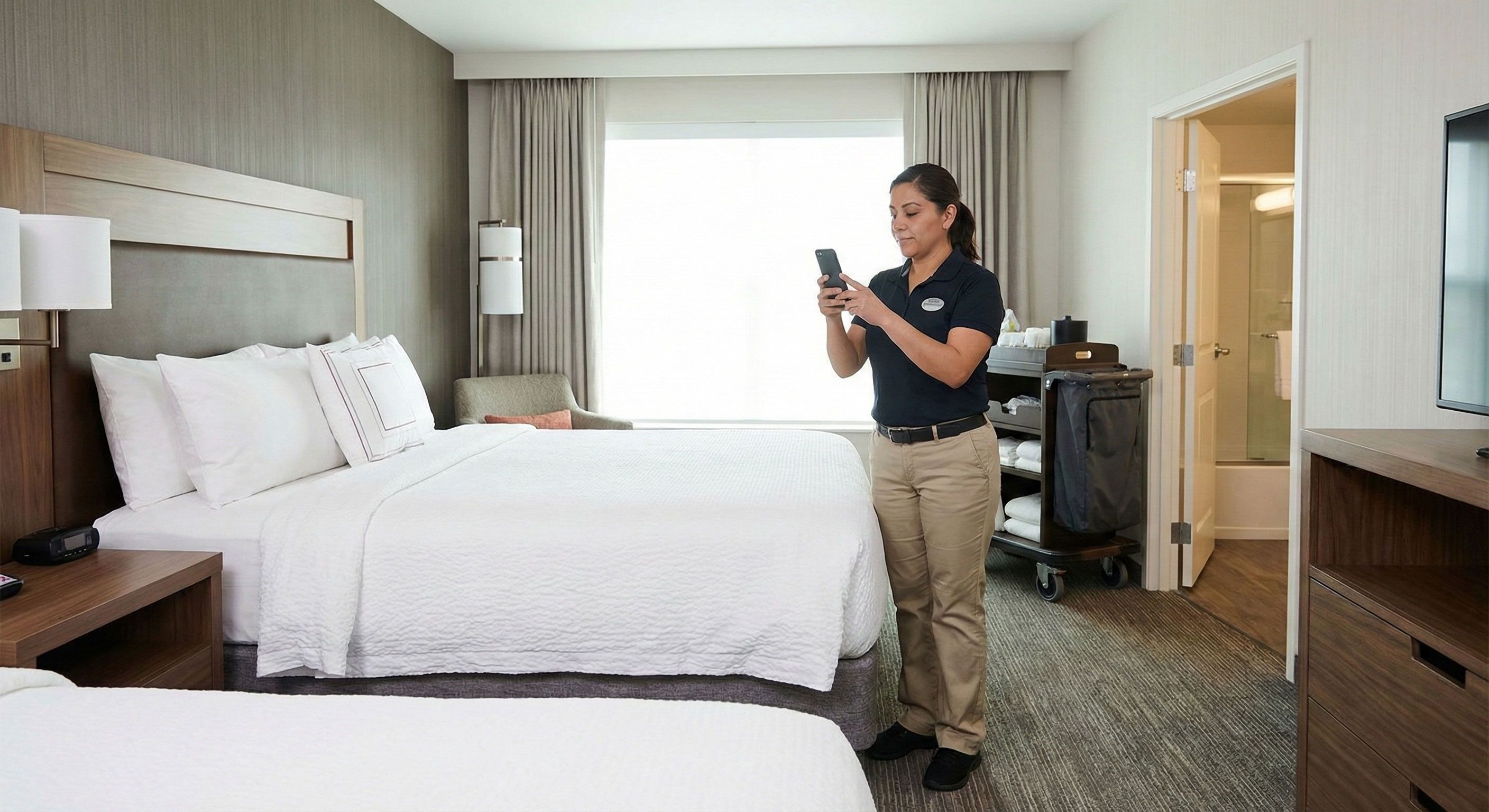
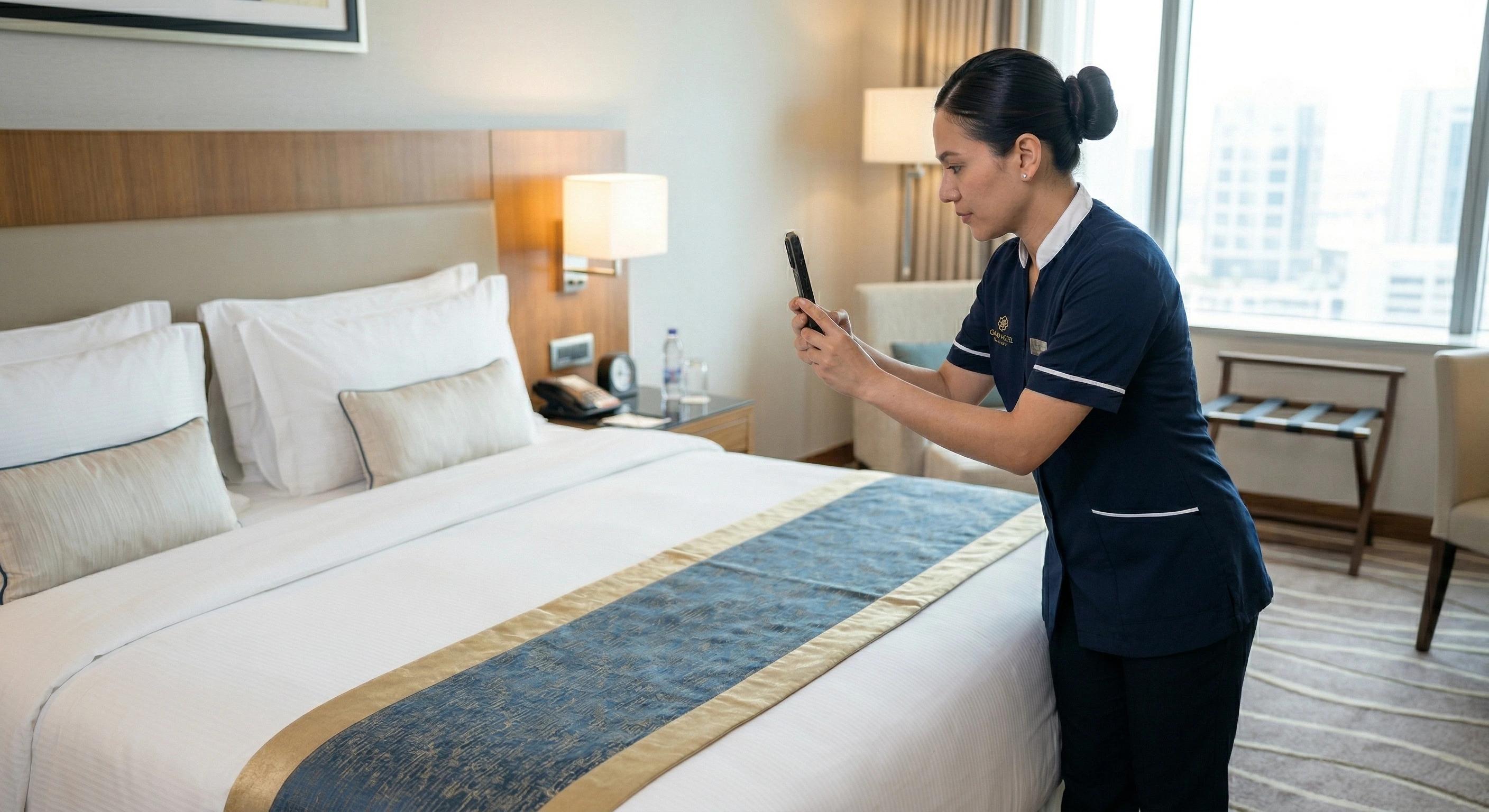
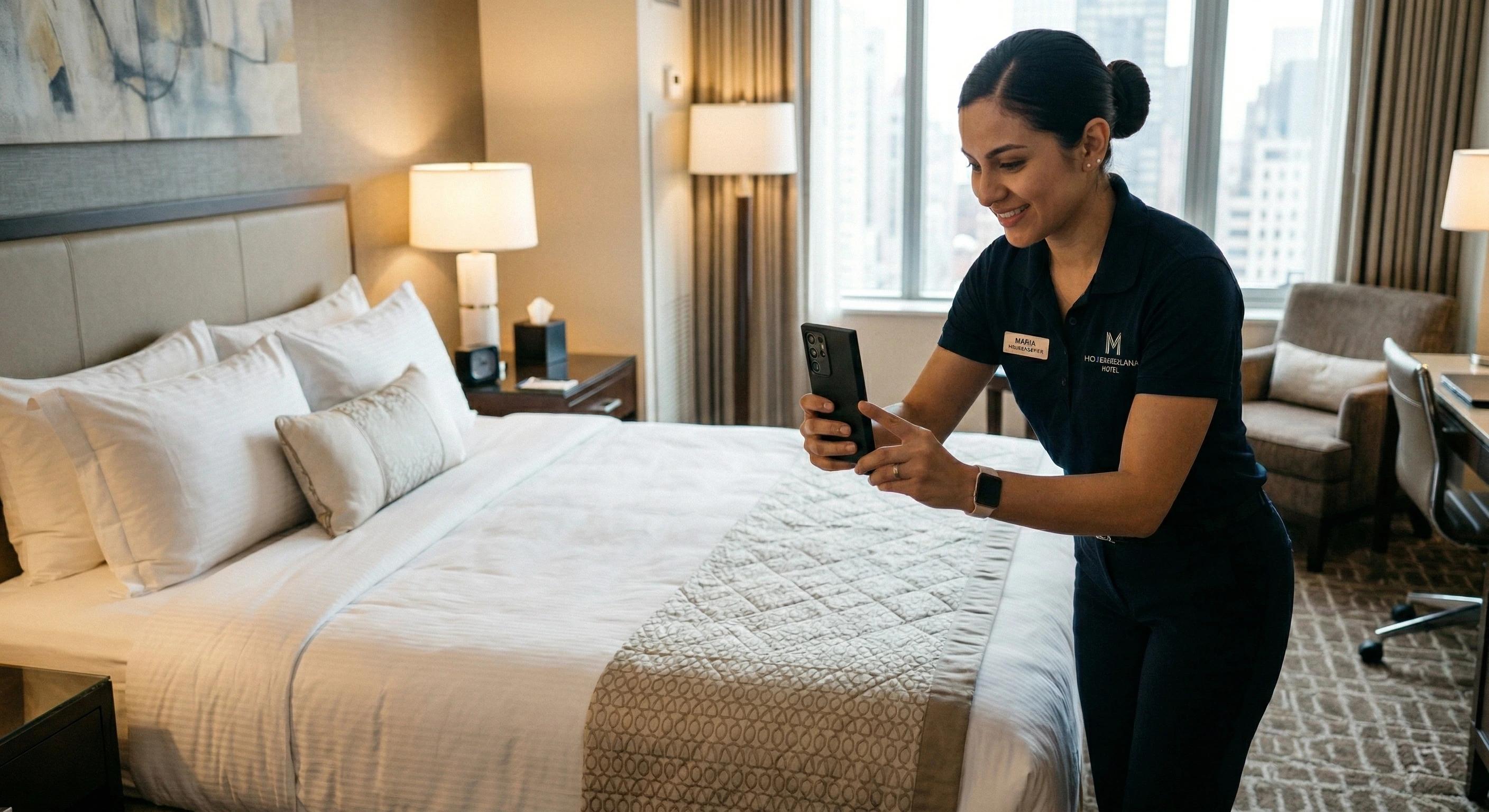
AI room inspections use computer vision to assess visual conditions in a room and compare what is seen against expected standards. In practice, that means a staff member captures images of a room and the system evaluates them for specific signals: cleanliness, room setup, missing items, visible defects, and other quality markers relevant to the property.
Fari Lens was built precisely for this kind of visual operations work. Within Fari’s product suite, it serves as the computer-vision layer for tasks such as cleanliness checks and other inspection-heavy workflows. Because Fari already connects with the systems hotels use to run operations, image-based findings do not remain trapped in a standalone app. They can become triggers for task creation, escalation, reconciliation, and reporting across departments.
That is the real operational shift. AI inspection is not merely about “seeing” the room. It is about converting visual information into action.
A room can be flagged as inspection-pending, inspection-passed, or inspection-failed with evidence attached. A maintenance issue can be routed immediately instead of waiting for a handwritten note or a delayed radio call. A repeat setup problem can be surfaced as a training issue rather than rediscovered one room at a time. Over time, the hotel builds a consistent visual record of how room quality is being executed, not just how it is described.
The efficiency gains begin with room readiness
The clearest operational benefit of AI room inspections is faster room readiness.
In many hotels, the gap between “housekeeping completed” and “front desk can confidently release the room” is larger than it should be. That gap is full of movement, verification, follow-up, and uncertainty. Supervisors must physically inspect rooms. Teams must clarify whether an issue is cosmetic or blocking. Front desk agents may wait for confirmation before checking in a guest. During peak arrival periods, these small delays become a serious throughput problem.
AI shortens this gap by compressing the time between completion and verification. A captured inspection can provide immediate, structured feedback. If the room meets standards, it can move more quickly toward release. If it fails, the reason is visible sooner, which reduces the back-and-forth that typically slows down reopening the room.
This matters operationally because room readiness is not an isolated housekeeping metric. It shapes front desk efficiency, upsell opportunities, guest wait times, and the hotel’s flexibility during compressed arrival windows. When inspection becomes faster and more reliable, the entire property becomes more responsive.
Standardization is where AI becomes managerial leverage
Operational efficiency is often discussed in terms of labor hours, but for hotel leaders, standardization may be the more strategic gain.
A hotel does not become efficient simply by doing things faster. It becomes efficient by reducing variance. The fewer surprises built into routine work, the easier it becomes to forecast, staff, coach, and recover.
AI room inspections help reduce variance by applying the same logic to every inspected room. That does not eliminate human oversight. It strengthens it. Supervisors no longer have to rely solely on memory, instinct, or uneven checklists. They can inspect against a more consistent framework, supported by image evidence and repeatable rules.
This is especially valuable in multi-property groups, large resorts, and high-volume urban hotels where inspection quality can drift across shifts and teams. A consistent visual inspection layer gives operations leaders a firmer grasp on whether standards are truly being executed, not merely assumed.
It also changes how managers spend their time. Instead of hunting for defects room by room, they can focus attention on exceptions, patterns, and coaching opportunities. That is a better use of managerial labor, and it is a more scalable one.
Earlier issue detection means less downstream rework
One of the hidden costs in hotel operations is rework. A room appears ready, but a stain is missed. A lamp is out. An amenity is absent. The bathroom setup is off brand. A maintenance issue is visible but unreported. None of these failures are catastrophic on their own. Together, they create a slow bleed of inefficiency.
When defects are detected late, the hotel pays multiple times. Housekeeping returns to the room. Engineering is pulled into a reactive task. Front office must manage room moves or delays. Guests may encounter inconvenience that could have been prevented entirely.
AI inspections improve efficiency by moving detection earlier in the process. The sooner the hotel identifies a visible issue, the cheaper it is to resolve. A problem caught during inspection is operational work. The same problem caught by the guest is service recovery.
This distinction matters. Operational work can be planned, routed, and measured. Service recovery is expensive, emotional, and brand-visible.
By making visible defects easier to identify and document, Fari Lens helps shift more issues into the first category and keep fewer in the second.
Better data makes housekeeping more manageable
Most hotels know how many rooms were cleaned. Far fewer know, with precision, why rooms fail inspection, which issues recur most often, or how inspection performance changes by shift, floor, room type, or attendant.
That is where AI inspections begin to act less like a point solution and more like an operating system input.
Because the inspection process is digital and evidence-based, hotels can start to answer questions that manual workflows rarely illuminate. Are certain room categories more prone to setup inconsistencies? Are repeated failures linked to staffing pressure on specific days? Do certain maintenance defects cluster by tower or floor? Which inspection failures are delaying room release most often?
These are management questions, not technology questions. But they become much easier to answer when the inspection workflow generates structured operational data.
Within Fari’s broader platform, this matters because room-inspection insight does not need to remain confined to housekeeping leadership. It can feed into cross-department coordination and analytics. The same company that positions Fari Lens as the visual layer and Fari Analytics as the reporting layer is effectively closing the loop between observation and decision-making. Inspection stops being a one-off task and becomes part of a measurable operating system.
AI room inspections improve labor allocation, not just labor savings
Hotels sometimes approach AI through the narrow lens of headcount reduction. That is usually the wrong frame for room inspections.
The more meaningful outcome is labor reallocation. When supervisors spend less time walking purely to confirm basics, they can spend more time on training, staffing coordination, exception handling, and service-level judgment. When room attendants receive clearer and earlier feedback, they waste less time on avoidable redo work. When engineering receives faster issue visibility, teams can prioritize based on operational impact instead of anecdotal urgency.
This is how AI improves efficiency in a labor-constrained environment. It does not replace the need for experienced operators. It increases the output of the operators a hotel already has.
That distinction is important in hospitality, where the human layer remains the differentiator. Guests do not choose a hotel because an inspection happened faster. They choose it because the room was ready, the standard was met, and nothing went wrong. AI succeeds here by making human service more reliable in the background.
The guest experience improves precisely because the process becomes less visible
The most effective hotel technology often disappears from the guest’s point of view. AI room inspections are a good example.
Guests do not ask whether a room was verified by a supervisor with a clipboard or by a workflow supported by computer vision. They care whether the room is clean, complete, and available when promised. They care whether maintenance issues were resolved before arrival. They care whether the property feels controlled.
By making inspections more consistent and by catching problems earlier, AI helps reduce the operational friction that guests eventually feel as waiting, inconsistency, or disappointment. Faster room release shortens check-in delays. Better defect detection reduces complaint volume. Stronger documentation supports quicker resolution when questions arise.
In that sense, operational efficiency and guest satisfaction are not separate outcomes. They are often the same outcome viewed from different sides of the lobby door.
Implementation matters more than hype
No serious hotel operator should adopt AI room inspections because the concept sounds modern. The case is operational, not theatrical.
What matters is whether the system fits existing workflows, integrates with the property’s technology stack, and can be trained around the visual realities of the hotel itself. That is why Fari’s approach is notable. The company’s own materials describe Fari as an intelligent layer that connects existing systems, while Fari Lens handles visual operations such as cleanliness checks. In practice, that architecture is more important than any single model claim. Hotels need inspection results to move into real workflows, not remain isolated on a dashboard.
Property-specific adaptation also matters. Room layouts, design standards, brand expectations, and visual environments vary widely. A meaningful AI inspection program must reflect the reality of the rooms being operated, not a generic template. That is part of what makes implementation discipline so important: successful deployment is as much about operational design as technical capability.
Hotels that roll out AI room inspections effectively tend to follow a familiar progression. They define the inspection standards that matter most. They align the workflow with housekeeping and engineering. They train staff on capture and exception handling. Then they monitor where the system is reducing delays, reducing rework, and improving room-release confidence.
The point is not to digitize a checklist. It is to redesign the inspection process so that quality control becomes faster, more consistent, and more measurable.
From inspection to orchestration
The broader significance of AI room inspections is that they represent a shift from isolated checking to operational orchestration.
In a traditional model, inspection is a pass-or-fail moment. In an AI-enabled model, inspection becomes a source of live operating intelligence. It can confirm readiness, trigger follow-up, document evidence, feed analytics, and expose patterns that improve future performance.
That is where Fari Lens becomes more than a camera-driven tool. In the context of Fari’s larger platform, it becomes one of the mechanisms through which the hotel sees its own operation more clearly and responds faster.
And that is ultimately why AI room inspections matter. Not because they make the hotel feel futuristic, but because they make it run with less friction. They help properties move rooms to ready status faster, enforce standards more consistently, catch issues sooner, use supervisory time more intelligently, and give leadership a clearer view of how quality is really being delivered.
In an industry where margins are tight, labor is precious, and the guest notices every failure, that kind of efficiency is not incremental. It is structural.