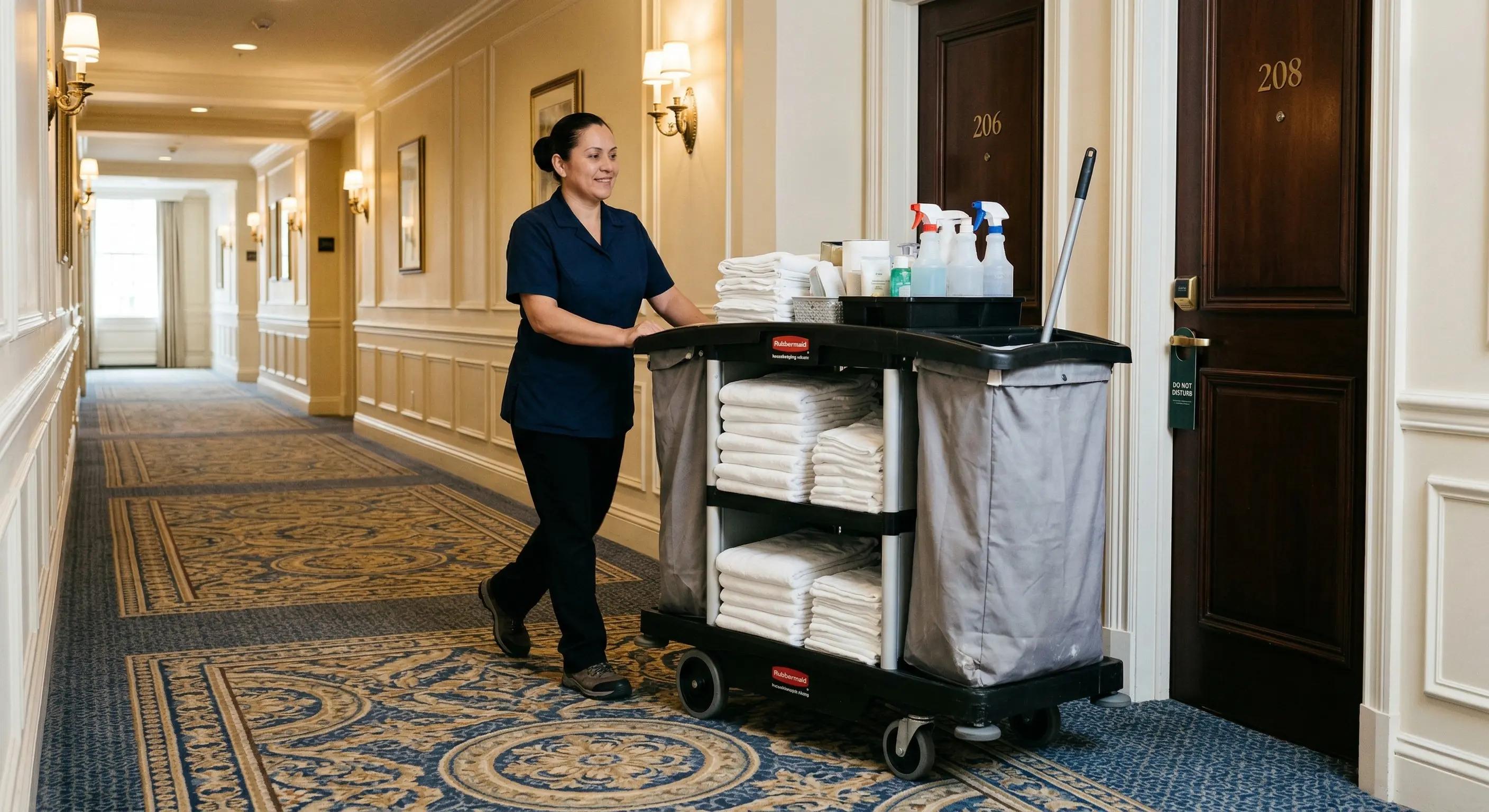
AI Housekeeping Audits for Hotel Facilities and Outsourcing Companies
How facilities management and outsourced housekeeping providers use Fari Lens to standardize audits, verify quality, and scale accountable hotel operations.

For facilities management companies and labor outsourcing firms that provide housekeeping services to hotels, quality is both the product and the problem. Clients buy labor, but what they really expect is consistency: rooms turned on time, standards followed precisely, missing amenities caught before check-in, damage flagged early, and documentation available when something goes wrong. At small scale, managers can approximate that consistency through supervision. At portfolio scale, across dozens of properties, hundreds of attendants, and thousands of rooms, that model starts to break down. Audits become uneven, supervisors spend their time walking floors instead of managing performance, and the same argument repeats itself after every complaint: was the room actually cleaned to standard, or did the team simply assume it was?
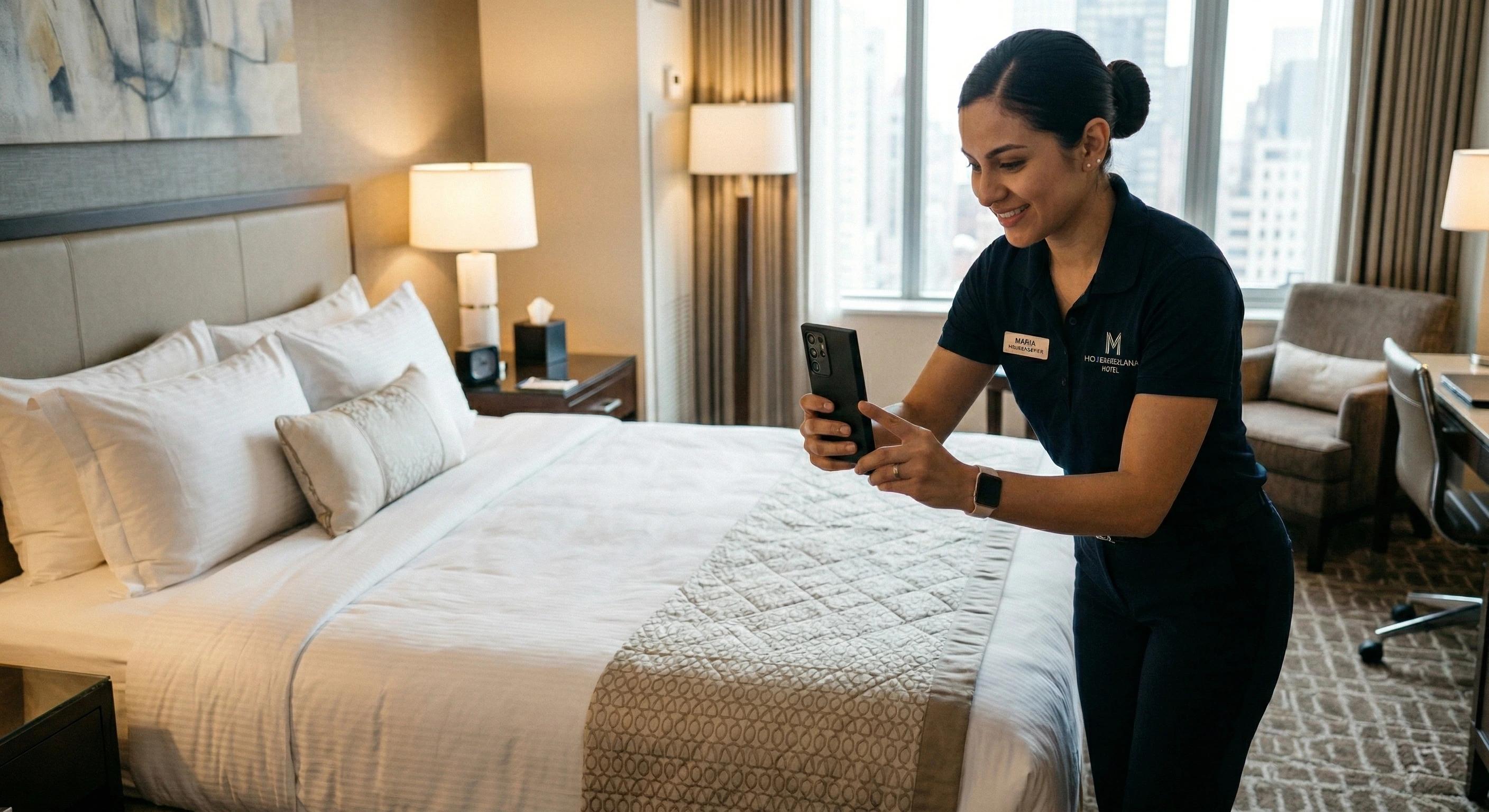
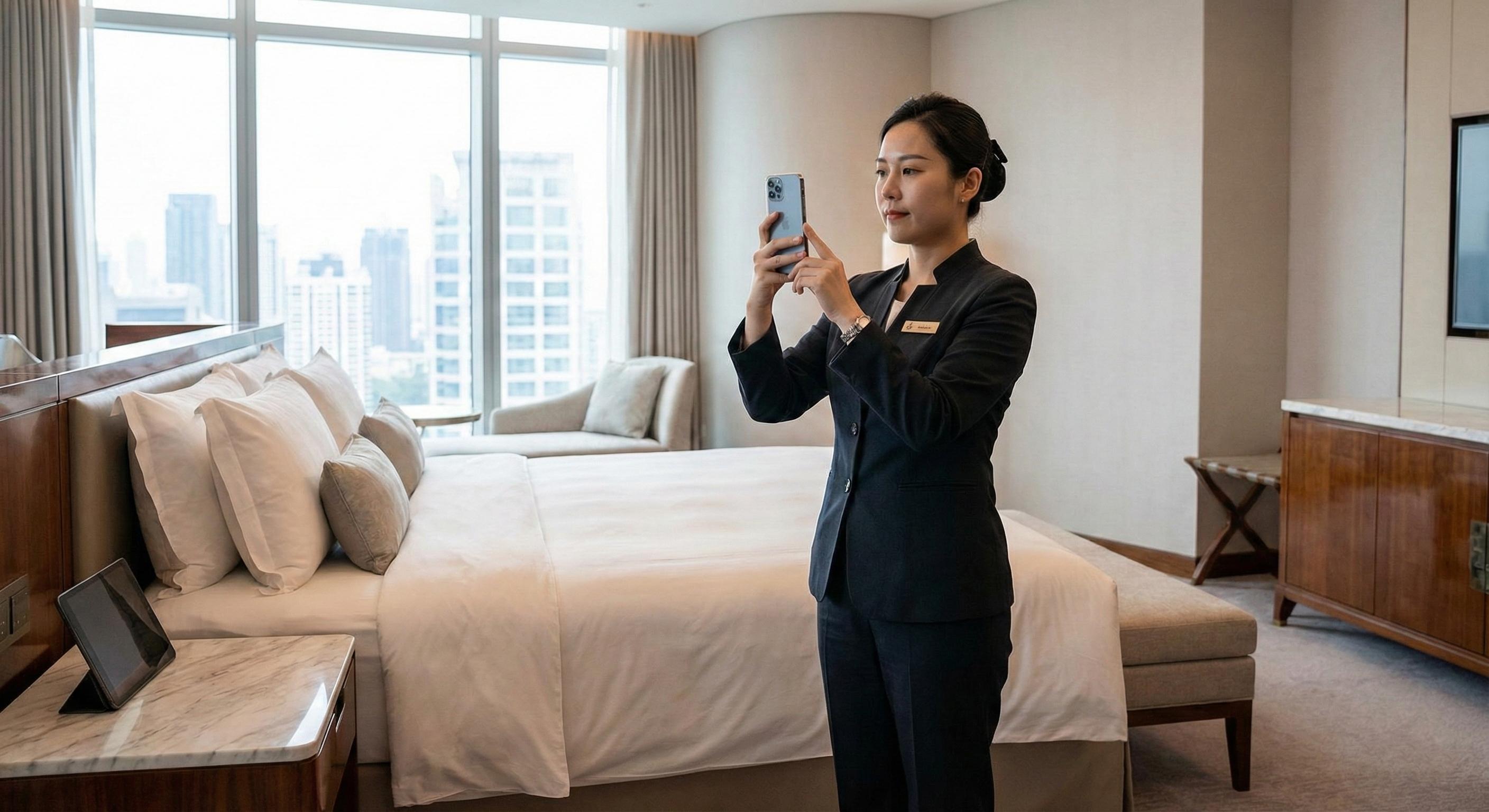
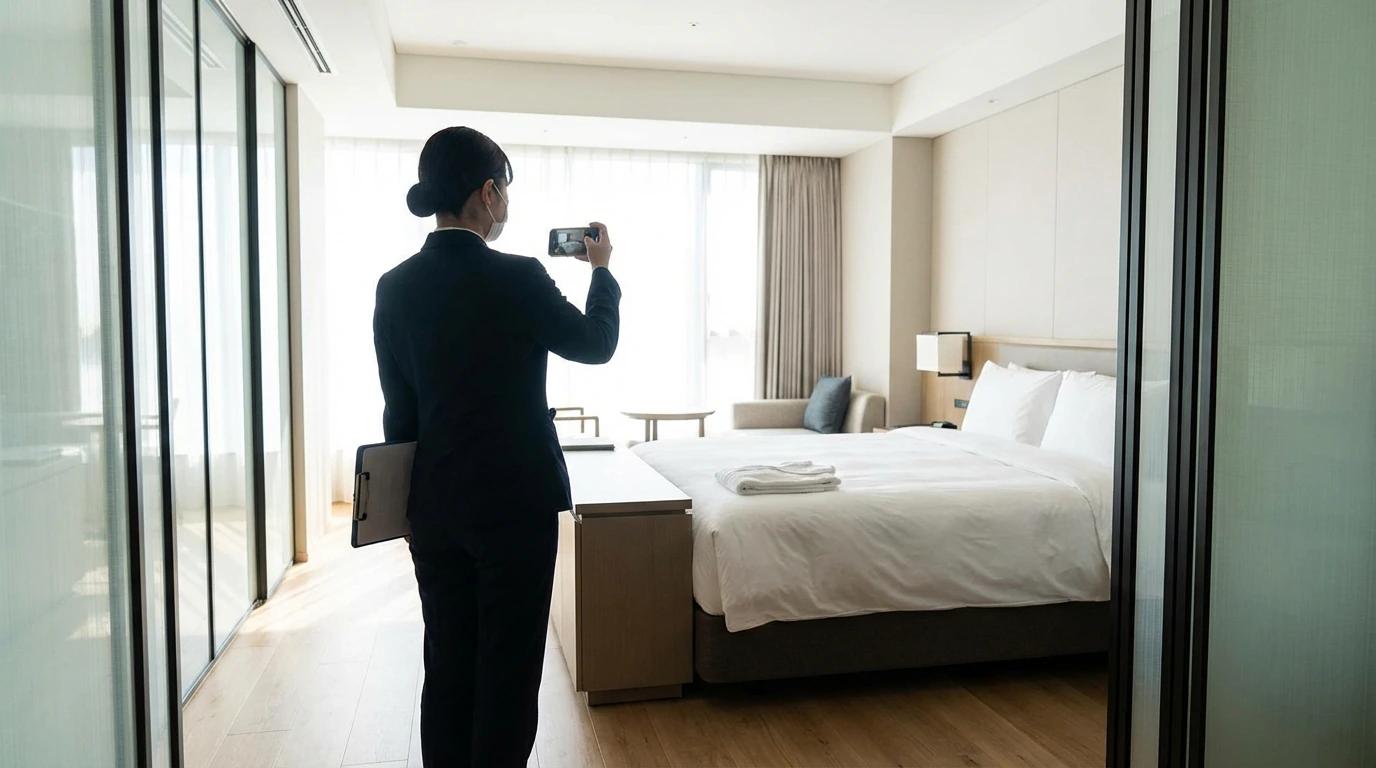
That is the operating context in which Fari Lens becomes valuable. The product is easy to describe but strategically important in practice: a computer vision application that uses mobile phone cameras and hotel-specific models to automate visual operational checks. In the housekeeping context, that means staff can photograph a room in the app and have the system analyze cleanliness conditions, missing amenities, maintenance needs, stains, damage, and whether standard setup protocols were followed. The result is not just faster inspection. It is a different operating model for outsourced housekeeping—one in which quality control becomes measurable, repeatable, and far easier to prove.
Why large-scale housekeeping audits are so difficult
The core challenge for outsourced housekeeping providers is that they are usually judged on outcomes they do not fully control, through processes that are rarely standardized. A hotel brand may define room readiness one way, an ownership group another, and an on-property executive housekeeper a third. Even when standards are documented, their enforcement is often manual. Supervisors sample rooms, complete checklists, send photos over messaging apps, and rely on memory or informal escalation when patterns emerge. That may work at a single property. It does not work cleanly when one company is managing staffing, audits, and service-level commitments across an entire regional portfolio.
Three structural problems tend to follow. First, audit coverage is limited. No supervisor can inspect every room with equal rigor, so quality assurance becomes selective by necessity. Second, audit quality varies by person. One inspector notices towel placement and amenity setup; another focuses on visible debris; a third flags maintenance only if it is severe. Third, documentation is weak. Even when issues are found, the evidence trail is fragmented across forms, text messages, and local knowledge, making it hard for a contractor to defend performance or identify recurring causes.
For facilities management firms, these weaknesses are expensive. They increase rework, prolong room release times, complicate staffing decisions, and create commercial risk in contract environments where penalties, renewals, and client trust depend on measurable service quality. They also make training harder. If there is no reliable record of what a failed room looked like, why it failed, and which standards were missed, improvement stays anecdotal.
What Fari Lens changes
Fari Lens changes the housekeeping audit from a subjective supervisory activity into a structured visual workflow. Staff photograph the room through the app, and the system analyzes the image set against the property’s configured standards. Because the models are fine-tuned to a hotel’s layouts, room types, amenity mix, and operating protocols, the product is not acting like a generic image classifier. It is evaluating whether a room appears ready in the specific way that property or hotel group defines readiness.
That matters especially for outsourcing companies, because their business depends on translating client expectations into repeatable field execution. A hotel may care deeply about towel placement, another about luxury amenity presentation, another about signs of wear before VIP arrivals. Fari Lens gives operators a way to encode those expectations into the audit process rather than hoping they survive handoffs between regional managers, site supervisors, and line staff.
The immediate benefit is scale. A supervisor no longer has to be physically present in every room to produce a meaningful quality record. The image becomes the audit event. The AI assessment becomes a standardized first pass. The timestamp becomes proof that the check happened. And because the photos are retained as records, management gains something manual systems almost never deliver cleanly at scale: auditability.
The business case for facilities management firms
For hotel operators, the value of better room audits is intuitive. For outsourced service providers, the value is broader. Fari Lens does not simply make inspections faster; it improves margin protection, contractual defensibility, labor productivity, and portfolio oversight. Those are distinct benefits, and each matters in a different part of the outsourcing business.
1. Standardization across properties
Most outsourcing firms struggle with uneven execution across sites. A flagship urban hotel may run tight audits because leadership is strong; a secondary airport property may drift because supervision is thin and turnover is high. Fari Lens helps narrow that gap by making the audit workflow itself more uniform. The same app, the same image capture pattern, the same configured expectations, and the same evidence structure can be deployed across multiple hotels while still allowing each property’s SOPs to be reflected in the model and setup.
2. More coverage without linearly adding supervisors
Traditional audit models scale poorly because more rooms usually require more supervisory labor. Computer vision improves that ratio. Supervisors can spend less time on routine verification and more time on exception management, coaching, and client communication. Instead of walking every corridor to confirm basics, they can focus on the rooms, shifts, or teams where failures are recurring or where standards are most commercially sensitive.
3. Better accountability in multi-employer environments
Outsourced housekeeping often sits inside a complicated accountability chain. The hotel owns the guest experience. The contractor manages labor. Supervisors oversee execution. Front office or guest relations discovers failures after the fact. In that environment, disputes over responsibility are common. Timestamped photo records create a cleaner chain of evidence. A contractor can show that a room was checked, what condition it appeared to be in, what issues were identified, and when the audit occurred. That does not eliminate disputes, but it changes them from opinion-driven arguments into evidence-driven conversations.
4. Faster feedback loops for training
Most housekeeping training is generic when it should be specific. Teams are told to improve room readiness, but not always shown the exact repeat failures that are hurting performance. Because Fari Lens produces visual documentation, supervisors can coach with real examples from the property: recurring amenity omissions, incomplete bathroom resets, missed stains, inconsistent bed presentation, or damage that went unreported. Over time, this makes training less abstract and more operationally useful.
5. Earlier maintenance detection
Housekeeping audits are not only about cleanliness. They are often the first point at which maintenance issues become visible: damaged fixtures, stained upholstery, broken accessories, wear in bathrooms, or missing in-room items. In manual workflows, those observations are inconsistently escalated. Fari Lens makes maintenance identification part of the same visual check, which is important for service contractors because maintenance neglect often shows up to clients as a housekeeping failure. Catching issues earlier reduces the number of rooms that reach the guest in visibly degraded condition and improves coordination with engineering or work-order teams.
Why this matters especially for outsourced housekeeping
There is a meaningful difference between a hotel using technology to improve its own department and a service provider using technology to run a contracted operation. In the second case, the tool becomes part of the provider’s operating system. It affects how the company proves service levels, differentiates itself in bids, protects renewals, and governs distributed labor.
That distinction is why Fari Lens is particularly well suited to facilities management firms, housekeeping contractors, and broader facilities outsourcing companies serving hospitality clients. These businesses need more than a checklist app. They need a way to industrialize quality assurance without making the process rigid, slow, or overly dependent on local managerial talent. They also need technology that can work even when client systems vary widely from one property to another.
Fari Lens is useful here because it can operate as a standalone application, without requiring integration to existing hotel systems, while still offering optional API connectivity when clients want deeper automation. That deployment flexibility matters in outsourcing contexts. One hotel client may be highly integrated and digitally mature; another may want better audit visibility without any change to PMS or operations software. A contractor can still run a more disciplined audit program in both environments.
From inspection tool to management layer
The deeper benefit of Fari Lens is not that it checks rooms. It is that it makes housekeeping performance legible at scale. Once every room check generates structured visual data, management can begin to see patterns that are otherwise hard to isolate. Which properties have the highest exception rates? Which room types fail most often? Which shift or vendor cluster needs more support? Which standards are routinely missed because the SOP is unrealistic rather than because staff are careless?
This is where the product starts to function as a management layer rather than merely a point solution. Fari Lens can give regional operations leaders a centralized view of room checks, task status, and audit evidence. For companies operating across multiple brands or owners, that visibility is strategically valuable. It enables portfolio-level quality governance instead of isolated site-level supervision. And where broader automation is needed, Fari AI and Fari’s integration layer can connect the visual signal to downstream workflows such as task routing, prioritization, escalation, and analytics.
Operational benefits that compound over time
Some benefits appear immediately: faster verification, stronger documentation, fewer missed room issues. Others compound over time and may matter even more. When audit evidence accumulates consistently, providers can benchmark properties more credibly. When training is tied to real examples, onboarding improves. When room failures are caught earlier, rework declines and turnover pressure eases. When maintenance issues are spotted before guest arrival, complaint rates fall and the housekeeping team stops absorbing blame for defects it did not create.
There is also a commercial effect. Outsourcing firms increasingly compete not just on wage arbitrage or staffing depth, but on process maturity and transparency. A provider that can show clients a structured, photo-verified audit methodology is offering something more defensible than promised supervision. It is offering evidence-based quality control. In a market where hotel operators are under pressure to do more with thinner labor pools and tighter margins, that kind of credibility can become a real differentiator.
How rollout should work
The smartest way to deploy Fari Lens in outsourced housekeeping is not as a grand technology program, but as an operating redesign with a clear audit objective. Start by defining what a passed room actually means for each client or property segment. Then collect representative imagery across room types, layouts, lighting conditions, and edge cases so the models are tuned to the real environment. Configure user roles, room taxonomy, and reference baselines. Train supervisors and attendants on image capture discipline. Pilot in one property or one cluster, compare audit consistency and room release performance, then scale with refinements rather than trying to standardize everything on day one.
That approach matches how the product is designed to be implemented: discovery and model training, system configuration, compact staff training, then property rollout with iterative refinement. For facilities management firms, that phased method is important because success depends less on the novelty of AI than on whether the workflow becomes part of everyday operations.
The strategic takeaway
Large-scale hotel housekeeping audits are ultimately a control problem. The question is not whether managers care about quality. The question is whether the operating model gives them a practical way to observe quality consistently across rooms, shifts, properties, and teams. Manual supervision alone rarely does. Fari Lens offers a more durable answer by turning room inspection into a visual, timestamped, and increasingly standardized workflow.
For facilities management and outsourced housekeeping providers, that shift is significant. It means less dependence on ad hoc inspection, better proof of performance, earlier detection of issues, more scalable oversight, and a stronger basis for training and client reporting. In other words, it moves housekeeping audits from a labor-heavy control function to a measurable operational system. And in hospitality outsourcing, that is where better margins, stronger renewals, and more reliable service usually begin.