Seeing the Work: Fari Lens and Fair Performance Analytics for Housekeeping Teams
How computer vision and Fari’s analytics layer turn housekeeping work into fair, privacy-conscious performance insights instead of surveillance.
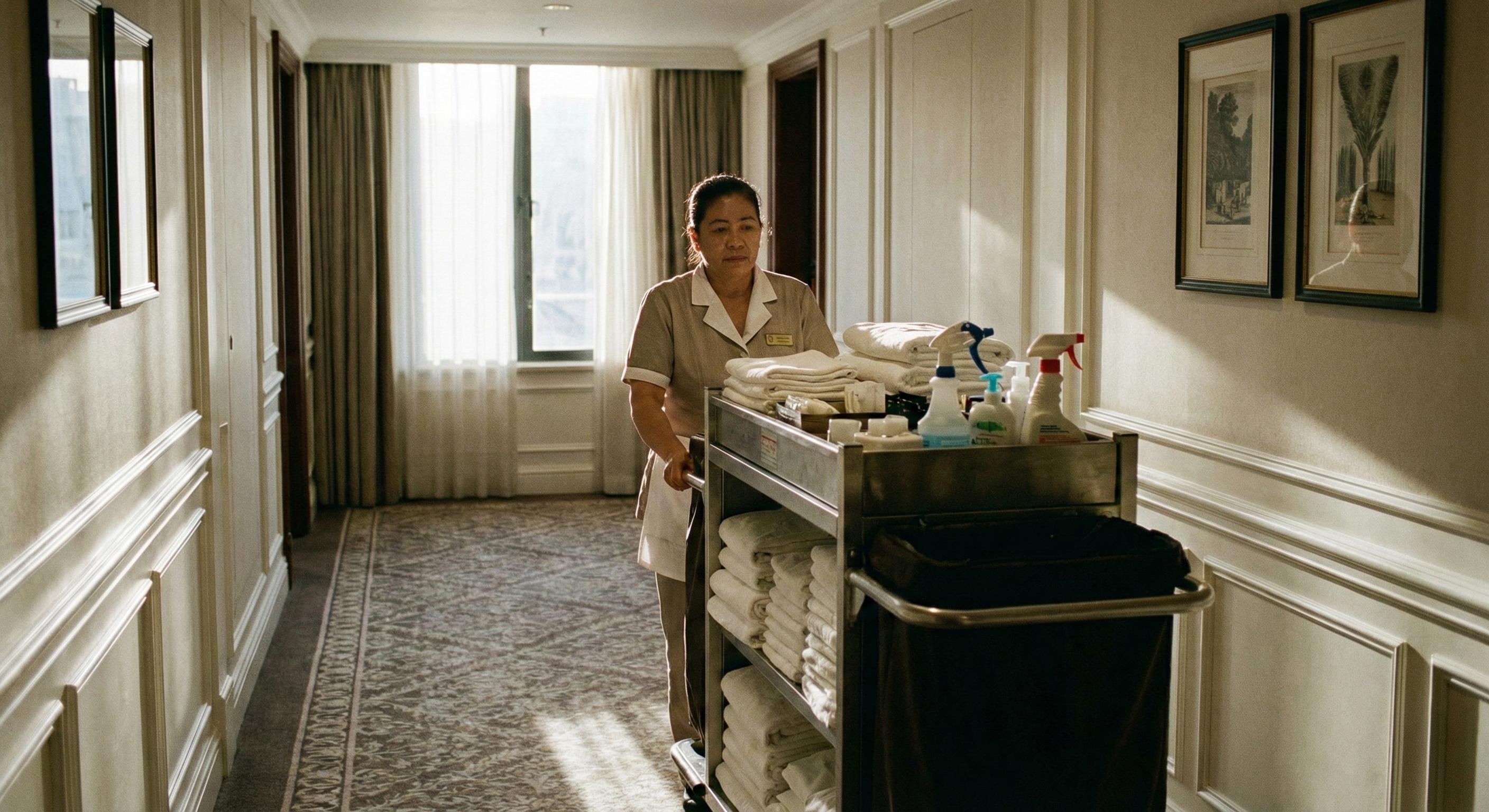
Walk any back corridor in a hotel and you will see the same pattern play out: carts lined with linen, radios crackling, doors propped open while teams race a checkout curve that rarely shows up clearly in the P&L. Housekeeping is almost always the largest single line item in hotel labour and one of the least instrumented.
Most properties know, to the decimal, their pickup, pace, and RevPAR. Far fewer can answer seemingly simple questions such as:
- How long does it actually take to turn a king room versus a twin when there was a late checkout?
- Which floors see the most rework after inspections, and why?
- Are weekend shifts systematically overloaded compared to weekdays, or does it just feel that way?
Fari Lens and the broader Fari platform do not magically “solve housekeeping” or replace supervisors. What they can do, in a grounded and practical way, is turn visual housekeeping work into structured data that feeds fair, explainable performance analytics, the kind that help teams rebalance labour, defend standards, and protect staff time, without drifting into black-box surveillance.
This piece unpacks how that works in detail, and where the line is drawn.
1. Housekeeping: the blind spot in hotel performance data
Housekeeping has historically been managed with clipboards, radios, and intuition. Even when a PMS or tasking system is in place, most of the real signal is still visual and ephemeral:
- A bed half made because a guest returned early.
- A minibar where two items have quietly disappeared.
- A bathroom that “looks fine” until a supervisor notices hair on the floor.
- A corridor where trolleys cluster because a team is waiting for rooms to vacate.
Supervisors see these things in the moment, but their observations rarely become structured data. The result is a management model built on partial information:
- Time standards are set once and then rarely revisited.
- Productivity is inferred from room counts rather than task complexity.
- Quality issues show up as guest complaints rather than operational metrics.
- Conversations about performance can feel arbitrary or unfair because they rely on memory instead of evidence.
Fari’s view is that you cannot have genuinely fair performance expectations for either management or staff without a more objective record of what work was done, in what conditions, and with what outcomes. That is where computer vision, carefully scoped, becomes useful.
2. What Fari Lens actually does in a room
Fari Lens is designed for “visual operations”: workflows where the facts live in images rather than forms. Today that includes minibar stocktaking, cleanliness checks, and F&B inventory, all tasks housekeepers and stewards already perform, just without a camera and a model looking over their shoulder.
In a typical housekeeping use case, the pattern looks like this:
- Structured capture, not free-form filming
A housekeeper uses a mobile device to take a small, predefined set of photos at specific points in the workflow, for example, minibar shelves, the bathroom vanity, and the bedroom overview after a clean. This is not continuous video or covert CCTV; it is a series of deliberate snapshots aligned with existing standards.
- On-device guidance and feedback
The app guides the user to frame what matters, for example “pan the minibar from left to right” or “capture the full bathroom floor”. If an image is too blurry or badly framed, the system can ask for a retake. The goal is not to judge the person but to ensure the model has enough signal to do its job.
- Computer vision turns pixels into facts
Once captured, images are processed by Fari’s models to detect and classify relevant elements. In minibar and cleanliness contexts, that can include:
- Which items are present or missing from a defined set.
- Whether towels, amenities, and key fixtures are in place.
- Obvious cleanliness issues, such as visible trash, unmade beds, or heavily soiled surfaces.
- Simple positional cues, such as whether curtains are open or closed when they are meant to be in a standard state.
The intent is narrow: translate what a trained supervisor would see in a photo into structured attributes that systems can work with.
- Events are created for the broader Fari platform
The extracted facts become events, such as “Room 1203 minibar short one item”, “Bathroom amenities incomplete”, or “Post-clean photo set completed at 14:37”, which the Fari platform can route into downstream systems, from work-order tools to the Fari analytics dashboard.
Importantly, the subject of these events is the room and its inventory, not the person holding the phone. The housekeeper is the operator, not the target.
3. From images to housekeeping performance metrics
Once visual events exist, performance analytics stops being about who “seems fast” and becomes about how work actually flows through the building. Fari Lens provides the raw material; Fari Analytics aggregates it into views that teams can act on.
3.1 Task-level signals
At the level of a single clean or inspection, computer vision outputs can support a richer set of metrics than a binary “room done/not done”:
- Time stamps for each stage
Because images are time-stamped, it becomes possible to see when the first photo is taken in a room and when the final post-clean set is completed. Combined with PMS and task data, this yields:
- Time from checkout to first entry.
- Time spent on the room, broken down by type, such as stayover versus checkout.
- Gaps where rooms sat idle because of late checkouts, Do Not Disturb, or sequencing choices.
- Quality signals tied to evidence
If the model flags missing amenities or visible issues, those flags can be linked to specific images. Supervisors reviewing the room have visual context for why a re-clean was requested. Over time, this builds:
- First-pass success rates for different room types or floors.
- Patterns in which issues recur, for example amenities versus linens versus minibars.
- Inventory accuracy at the point of work
For minibars and other in-room stock, Lens can compare what it sees to the expected configuration. Variances become structured events instead of handwritten notes. When reconciled against charges, that opens up:
- Accuracy metrics for in-room posting workflows.
- Identification of rooms, times of day, or stocking patterns that drive the most leakage.
None of these metrics require guessing about a person’s intent. They simply expose, with evidence, how rooms move from dirty to clean and how inventory moves from shelf to folio.
3.2 Team and property-level views
Where the combination of Fari Lens and Fari Analytics really helps housekeeping leaders is in rolling these task-level signals up into patterns that are hard to see from the corridor.
Examples include:
- Realistic time standards by room type and condition
Instead of setting universal targets, for example “18 minutes per room”, and arguing about exceptions, properties can compute empirical distributions:
- Median and 90th percentile clean times for checkouts versus stayovers.
- The impact of late checkouts, extra beds, or specific packages on cleaning time.
This gives both management and staff a more objective basis for planning and negotiation.
- Rework rates by shift, floor, or room stack
If repeated issues are caught by supervisors or guest feedback, you can see whether they cluster:
- In particular parts of the building, such as older rooms or awkward layouts.
- At certain times, such as end of shift or compressed turnarounds.
- Around specific steps, for example bathrooms are fine but minibars are not.
The emphasis is on process design and support, for example adjusting routing or training, rather than singling out individuals without context.
- Workload balancing and route optimisation
When each room’s clean has time stamps and quality markers, you can see whether some routes are chronically overloaded. This enables:
- Fairer distribution of heavy checkout banks.
- Smoother staggering of early arrivals and late checkouts.
- Evidence-backed conversations when teams say “this corridor is impossible to finish on time”.
Again, the key is that Lens provides structured, explainable inputs, while the judgment about targets and staffing remains with human leaders.
4. Using analytics to support, not surveil, housekeepers
Any time you put cameras and metrics near people’s work, the obvious concern is whether we are sliding into surveillance.
Fari’s philosophy, and the way Lens is used in practice, is that analytics should first protect staff from unreasonable expectations and ungrounded blame. That means:
- Make the room, not the person, the primary unit of analysis
Dashboards focus on rooms, routes, and shifts rather than individual scorecards by default. When patterns do point toward a specific person or small group, supervisors have image-backed context to understand whether they are facing systematically harder assignments.
- Use evidence to challenge unrealistic narratives
When a complaint arises, such as “this floor is always slow” or “evening shift does not pull its weight”, leaders can pull data on actual clean times, rework rates, and room conditions. Often, the data shows the constraint is late checkouts, uneven distribution of suites, or batch arrivals, all operational issues rather than individual underperformance.
- Separate coaching from enforcement
Because Lens events come with linked images, supervisors can use them as coaching tools, walking through a post-clean photo side by side with a housekeeper and discussing what meets or misses the standard. That is a different posture from using opaque scores to threaten disciplinary action.
- Make metrics transparent
A critical safeguard is sharing with teams what is being measured, how, and why. If a property uses Fari Analytics to track first-pass success or typical clean times, that should be explicit, and staff should see the same charts managers do. When people understand how they are being evaluated, the system feels less like a hidden camera and more like a shared reference point.
Lens and Analytics provide the instrumentation. Whether the resulting data is used to support or undermine staff is ultimately a governance choice, but the platform is built to make that choice explicit and auditable, not implicit and unexamined.
5. Designing fair performance programs with Fari Lens and Fari Analytics
With the raw data in place, the question becomes what a responsible housekeeping performance program actually looks like.
Here is one pattern that has emerged from properties experimenting with visual operations data.
Step 1: Align on outcomes, not surveillance
Before turning on any new metrics, leadership should articulate the outcomes they care about and which they will not pursue. For example:
- Outcomes to improve:
- Consistency of standards across floors and shifts.
- Predictability of room readiness for arrivals.
- Reduction in rework that burns time and morale.
- Outcomes to avoid:
- “Gotcha” tracking of individuals for minor infractions.
- Constant escalation of time pressure without redesigning routes.
This becomes the rubric for how Lens and Analytics will be configured and governed.
Step 2: Start with anonymous or aggregated views
Early phases can focus on aggregate insights:
- Property-level distributions of clean times.
- Rework rates by room type.
- Variance between weekdays and weekends.
At this stage, you can often unlock quick wins, such as adjusting shift patterns or rebalancing assignments, without linking metrics to names at all. That gives teams confidence that the goal is process improvement, not surveillance.
Step 3: Introduce opt-in, team-led experiments
When individual-level views are introduced, do it with clear purpose and consent. For example:
- A small housekeeping team volunteers to pilot detailed analytics for a month.
- The focus is on testing whether certain routing changes reduce overtime without hurting standards.
- Both supervisors and housekeepers can see their metrics in Fari Analytics, with explanations for how they will and will not be used.
If the experiment shows that the data helps protect the team, for instance by proving that a set of rooms is structurally understaffed, it builds trust in the tool.
Step 4: Embed safeguards and review points
Finally, properties can encode safeguards around data use:
- Limits on who can see individual-level metrics.
- Clear retention policies for images versus derived events.
- Scheduled reviews with staff representatives to ensure metrics remain aligned with operational reality and labour agreements.
Fari’s role is to provide the levers, role-based access, audit trails, and configurable analytics, so that hotels can implement these policies in a traceable way rather than informal practice.
6. Practical housekeeping scenarios powered by Fari Lens
To make all of this more concrete, consider a few realistic scenarios.
Scenario A: Shrinking the “room is not ready” gap
A city hotel frequently misses 15:00 check-in on high floors. Operations suspects the issue is “slow cleaning”, but frontline teams insist the problem is late checkouts and bunching.
By instrumenting post-clean photos with Fari Lens and surfacing time stamps in Fari Analytics, the property can see:
- The average time from checkout posting to first entry on those floors.
- The distribution of clean durations once a room is actually accessible.
- The share of rooms where quality flags triggered rework.
In many cases, this reveals that housekeepers are actually hitting reasonable time standards once they can start, but are being scheduled as if every checkout happened at noon. The fix is a different arrival promise on those floors or adjusted staffing at specific hours, not pressure on the team to do the impossible.
Scenario B: Understanding rework without blame
Another property sees a spike in supervisor re-cleans on a particular wing. Historically, this might have led to formal warnings or tense stand-up meetings.
With Lens in place, supervisors and managers can review tagged images to see:
- Whether issues are clustered around one type of room, for example family suites with more surfaces.
- Whether missing items are due to stockouts rather than missed steps.
- Whether rework correlates with compressed turnaround windows.
This makes it easier to distinguish between:
- A training gap, for example newer team members missing a specific detail.
- A stocking problem, carts not replenished with needed amenities.
- A structural issue, room types that merit more time in the roster.
Conversations can then focus on redesigning work rather than assigning fault in a vacuum.
Scenario C: Minibar accountability without confrontation
Minibars are infamous sources of friction: guests dispute charges, staff feel accused, and managers suspect leakage. Fari Lens can document minibar state at the point of clean in a way that protects everyone:
- Housekeepers capture quick minibar photos as part of their normal routine.
- Computer vision identifies missing items and prompts for confirmation.
- Charges are posted with an attached image, which can be referenced later if a guest or manager has questions.
Beyond financial accuracy, this gives supervisors a way to see how much minibar work is actually being asked of each route and whether standards are realistic given the number of stocked items.
7. What Fari Lens does not do
It is just as important to be clear about what Fari Lens is not designed to do in a housekeeping context:
- No behavioural scoring based on posture or expression.
- No continuous tracking of physical location.
- No automatic HR decisions.
- No hidden metrics.
The most effective deployments are explicit about what is being captured and why. If a property chooses to use Fari Analytics for individual performance reviews, that should be a deliberate, communicated policy choice, not an accidental side effect.
Stating these boundaries upfront helps keep computer vision where it belongs, as a tool for understanding work and improving processes, not as a mechanism for dehumanising them.
8. The bigger picture: labour optimisation as shared relief, not just savings
When operators talk about “labour optimisation”, staff often hear “job cuts”. Fari’s framing is different: the first gains from visual operations and analytics normally show up as relief and predictability rather than headcount reductions.
In housekeeping, that can mean:
- Fewer last-minute panics because room readiness is tracked in real time with evidence.
- Less rework because standards are clearer and issues are caught earlier.
- More grounded staffing models that acknowledge the real complexity of certain room types or days.
- Stronger justification for investments in equipment, training, or additional hours when data shows that current expectations are unrealistic.
Over the long run, better alignment between workload, standards, and staffing does protect margins. But the path there is not through squeezing more rooms per person at any cost. It is through making visible the operational realities that both managers and housekeepers have been trying to navigate by feel.
By using Fari Lens to capture those realities, and Fari Analytics to interpret them, hotels can move toward a model of performance management that is rigorous without being punitive, and data-driven without losing sight of the people doing the work.
The cameras, in other words, are not there to watch housekeepers. They are there to finally see the work.